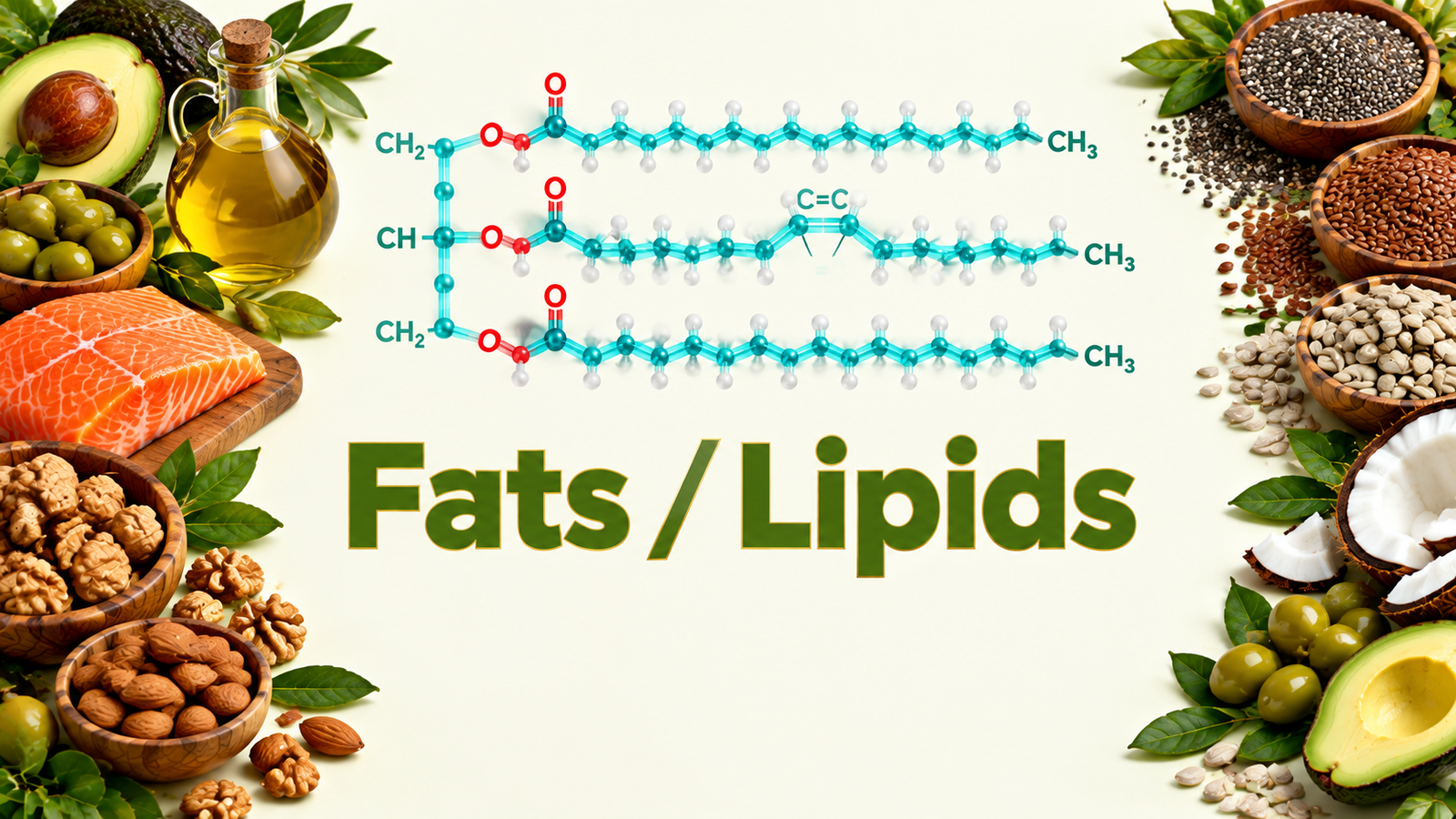
Fats (lipids) are a concentrated source of energy that also build cell membranes, make hormones, protect organs and help absorb vitamins A, D, E and K. Fat is essential, but the type of fat matters more than the total.
What is it?
Fat provides about 9 kilocalories per gram, more than twice as much as carbohydrate or protein. Most dietary fat is triglyceride, made of three fatty acids on a glycerol backbone. Other lipids include phospholipids and sterols such as cholesterol. Fatty acids are saturated, monounsaturated, polyunsaturated or trans, and each has different effects on health. See Fatty acids and Lipid forms.
What it does
- Provide concentrated energy and stored energy
- Make up cell membranes and the insulating layer around nerves
- Are needed to make hormones
- Carry and help absorb vitamins A, D, E and K
- Provide essential fatty acids the body cannot make
- Make food more satisfying and flavourful
Food sources
Cooking oils, butter and ghee, nuts and seeds, avocado, oily fish, meat and poultry (with fat and skin), dairy, eggs, coconut milk and cream, and many processed and fried foods. Choose unsaturated fats from fish, nuts, seeds and plant oils more often.
Singapore food examples
- Healthier choices: fish, nuts, seeds, avocado and olive, canola, peanut or sunflower oil
- Coconut milk and santan in curries, laksa, rendang and nasi lemak — enjoy in smaller portions
- Fried foods — fried chicken, goreng pisang, curry puffs, fried noodles and deep-fried snacks
- Fatty cuts of meat, chicken skin, lard and processed meats
- Ghee and butter in prata and baked goods
- Peanut-based sauces and satay gravy in moderation
How much do I need?
Singapore's dietary guidelines suggest that total fat provide 30 to 35 percent of daily energy and saturated fat less than 10 percent — see Singapore's dietary guidelines for adults (HealthHub). Singapore's RDA table does not list a fat figure.
The US National Academies suggest 20 to 35 percent of energy from fat, and set Adequate Intakes for the two essential fatty acids, linoleic and alpha-linolenic acid (see Fatty acids).
Low intake and deficiency
Very low-fat diets can reduce absorption of fat-soluble vitamins and carotenoids, lower essential fatty acid intake and make meals less filling. True essential fatty acid deficiency is rare and causes dry, scaly skin, poor wound healing and poor growth, and is seen with severe fat malabsorption or long-term intravenous feeding without lipid.
Too much and safety
Fat is energy-dense, so overeating it can lead to weight gain. Too much saturated and trans fat raises LDL ("bad") cholesterol and the risk of heart disease. Fat that is not used is stored; fat stored around the abdomen and liver is linked to higher risk of diabetes and fatty liver.
Absorption and bioavailability
Fat is digested with the help of bile from the liver and enzymes (lipases) from the pancreas, absorbed in the small intestine and carried in the blood in particles (chylomicrons, then lipoproteins). Problems with bile, the pancreas or the gut lining can cause fat malabsorption, with greasy, pale, floating stools and weight loss; see a doctor.
Eating a little fat with vegetables rich in carotenoids and vitamins A, D, E and K improves absorption.
Connection to daily life
- Heart health: replacing saturated and trans fat with unsaturated fat lowers heart disease risk
- Brain and eyes: omega-3 fats are part of nerve and retina membranes
- Exercise: fat is the main fuel for long, lower-intensity exercise — see Exercise
- Healthy ageing: fish and nut-based eating patterns are linked with better heart and brain health
Sources: 1. National Academies of Sciences, Engineering, and Medicine — Dietary Reference Intakes for Energy, Carbohydrate, Fiber, Fat, Fatty Acids, Cholesterol, Protein, and Amino Acids (2005) 2. HealthHub Singapore — Recommended Dietary Allowances: https://www.healthhub.sg/well-being-and-lifestyle/food-diet-and-nutrition/recommended_dietary_allowances 3. HealthHub Singapore — Dietary guidelines for adults: https://www.healthhub.sg/well-being-and-lifestyle/food-diet-and-nutrition/dietary_guidelines_adults 4. Health Promotion Board — Singapore Food Insights Database (SG FoodID): https://www.hpb.gov.sg/healthy-living/food-and-beverage/sgfoodid/ 5. FAO/INFOODS — Food composition tables and databases: https://www.fao.org/food-composition/tables-and-databases/en/

Comments
No comments yet.
Log in to leave a comment.