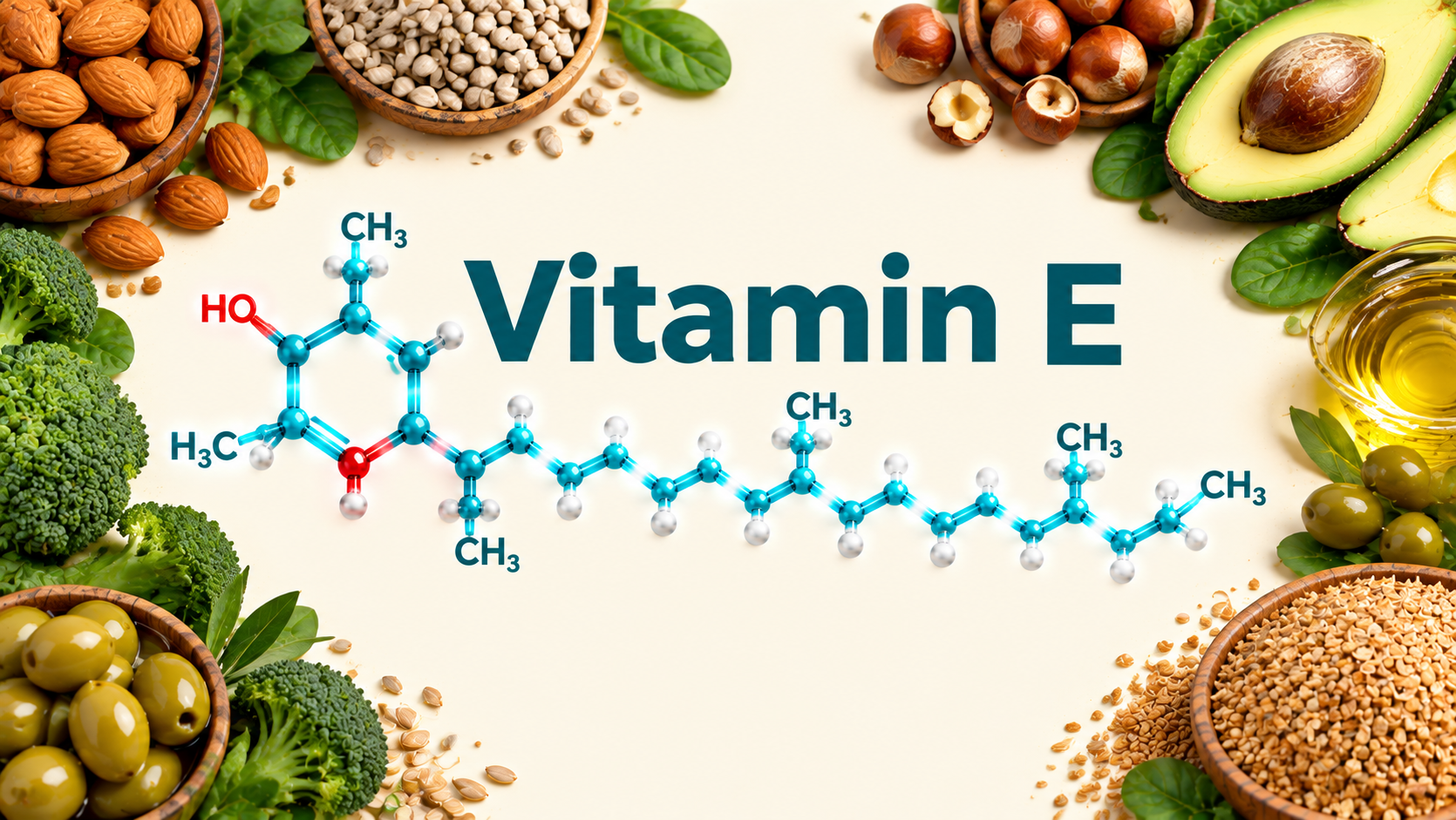
Vitamin E is a fat-soluble antioxidant that helps protect cells from oxidative damage. It's concentrated mainly in nuts, seeds and vegetable oils rather than animal foods.
What is it?
Vitamin E is the name for a family of eight fat-soluble compounds: four tocopherols (alpha, beta, gamma, delta) and four tocotrienols. Alpha-tocopherol is the only form that meets human requirements, so intake recommendations are expressed as alpha-tocopherol. The other forms, including tocotrienols found in palm oil, are present in food and are being researched.
What it does
- Acts as an antioxidant, protecting the fats in cell membranes from damage by free radicals
- Supports normal immune function
- Helps widen blood vessels and keep blood from clotting abnormally inside them
- Helps cells communicate and regulate gene activity
Food sources
Wheat germ oil, sunflower seeds, sunflower and safflower oil, almonds, hazelnuts and peanuts are by far the richest sources. Smaller amounts come from spinach, broccoli, mango, avocado, kiwi and other vegetables and fruit. Most intake in typical diets comes from vegetable oils, nuts and seeds and grain products.
Singapore food examples
- Almonds, peanuts and sunflower seeds as snacks, or in cereal and yoghurt
- Sunflower, canola, olive and other vegetable oils in cooking and dressings
- Palm oil in some local cooking (it contains tocopherols and tocotrienols)
- Spinach, kai lan and broccoli
- Mango, avocado and kiwi
- Peanut butter and nut-based sauces, in moderation
How much do I need?
Singapore's RDA table does not list vitamin E. The US National Academies set an RDA of 15 mg (22.4 IU of natural vitamin E) of alpha-tocopherol a day for adults, 15 mg in pregnancy and 19 mg while breastfeeding. Most people get close to this from a varied diet that includes nuts, seeds and oils. See Singapore's age- and sex-specific Recommended Dietary Allowances (HealthHub) for the nutrients Singapore does list.
Low intake and deficiency
Deficiency from diet alone is rare. It occurs mainly in people who cannot absorb fat properly — for example, with cystic fibrosis, cholestatic liver disease or certain inherited disorders — and in very premature babies. Symptoms include nerve and muscle damage causing numbness, balance and coordination problems, muscle weakness, vision problems and a weakened immune system.
Too much and safety
Vitamin E from food is safe. The upper limit for adults is 1,000 mg a day of alpha-tocopherol from supplements. Large doses can interfere with blood clotting and raise the risk of bleeding, including bleeding in the brain.
Vitamin E supplements can interact with blood thinners (warfarin, aspirin and others), and with some cancer treatments and cholesterol medicines. A large trial found that men taking 400 IU a day had a higher risk of prostate cancer. Do not take high-dose supplements without medical advice.
Absorption and bioavailability
Vitamin E is fat-soluble, so it needs some fat in the meal to be absorbed — nuts and oils bring their own. Pairing salad vegetables with a little oil or nuts helps absorption.
Natural vitamin E (RRR-alpha-tocopherol, "d-alpha") is about twice as potent as the synthetic form (all-rac, "dl-alpha"). Heating oils for a long time, repeated deep-frying, light and air destroy vitamin E, so store oils sealed, in a cool, dark place.
Connection to daily life
- Healthy ageing: an antioxidant that may support immune function in older adults, though supplements have not been shown to prevent chronic disease
- Heart health: nuts, seeds and unsaturated oils that provide vitamin E also support heart-healthy eating patterns
- Skin: used in skin care products, though eating enough is what counts for the body
- Eye health: vitamin E is part of the AREDS2 formula studied for age-related macular degeneration, but only under eye-specialist advice
- Works with Vitamin C, which helps recycle used vitamin E
Food sources table
Amounts per serving from NIH data, ranked from highest to lowest.
Food | mg per serving | % DV |
|---|---|---|
Wheat germ oil, 1 tablespoon | 20.3 | 135 |
Sunflower seeds, dry roasted, 1 ounce | 7.4 | 49 |
Almonds, dry roasted, 1 ounce | 6.8 | 45 |
Sunflower oil, 1 tablespoon | 5.6 | 37 |
Safflower oil, 1 tablespoon | 4.6 | 31 |
Hazelnuts, dry roasted, 1 ounce | 4.3 | 29 |
Peanut butter, 2 tablespoons | 2.9 | 19 |
Peanuts, dry roasted, 1 ounce | 2.2 | 15 |
Corn oil, 1 tablespoon | 1.9 | 13 |
Spinach, boiled, ½ cup | 1.9 | 13 |
Broccoli, chopped, boiled, ½ cup | 1.2 | 8 |
Soybean oil, 1 tablespoon | 1.1 | 7 |
Kiwifruit, 1 medium | 1.1 | 7 |
Mango, sliced, ½ cup | 0.7 | 5 |
Tomato, raw, 1 medium | 0.7 | 5 |
Spinach, raw, 1 cup | 0.6 | 4 |
Sources: 1. NIH Office of Dietary Supplements — Vitamin E Fact Sheet for Health Professionals: https://ods.od.nih.gov/factsheets/VitaminE-HealthProfessional/ 2. HealthHub Singapore — Recommended Dietary Allowances: https://www.healthhub.sg/well-being-and-lifestyle/food-diet-and-nutrition/recommended_dietary_allowances 3. Health Promotion Board — Singapore Food Insights Database (SG FoodID): https://www.hpb.gov.sg/healthy-living/food-and-beverage/sgfoodid/ 4. FAO/INFOODS — Food composition tables and databases: https://www.fao.org/food-composition/tables-and-databases/en/ 5. NIH Office of Dietary Supplements — all fact sheets: https://ods.od.nih.gov/factsheets/list-all/ Food sources table: National Institutes of Health, Office of Dietary Supplements — Vitamin E Fact Sheet for Health Professionals, Table 2.
Comments
No comments yet.
Log in to leave a comment.