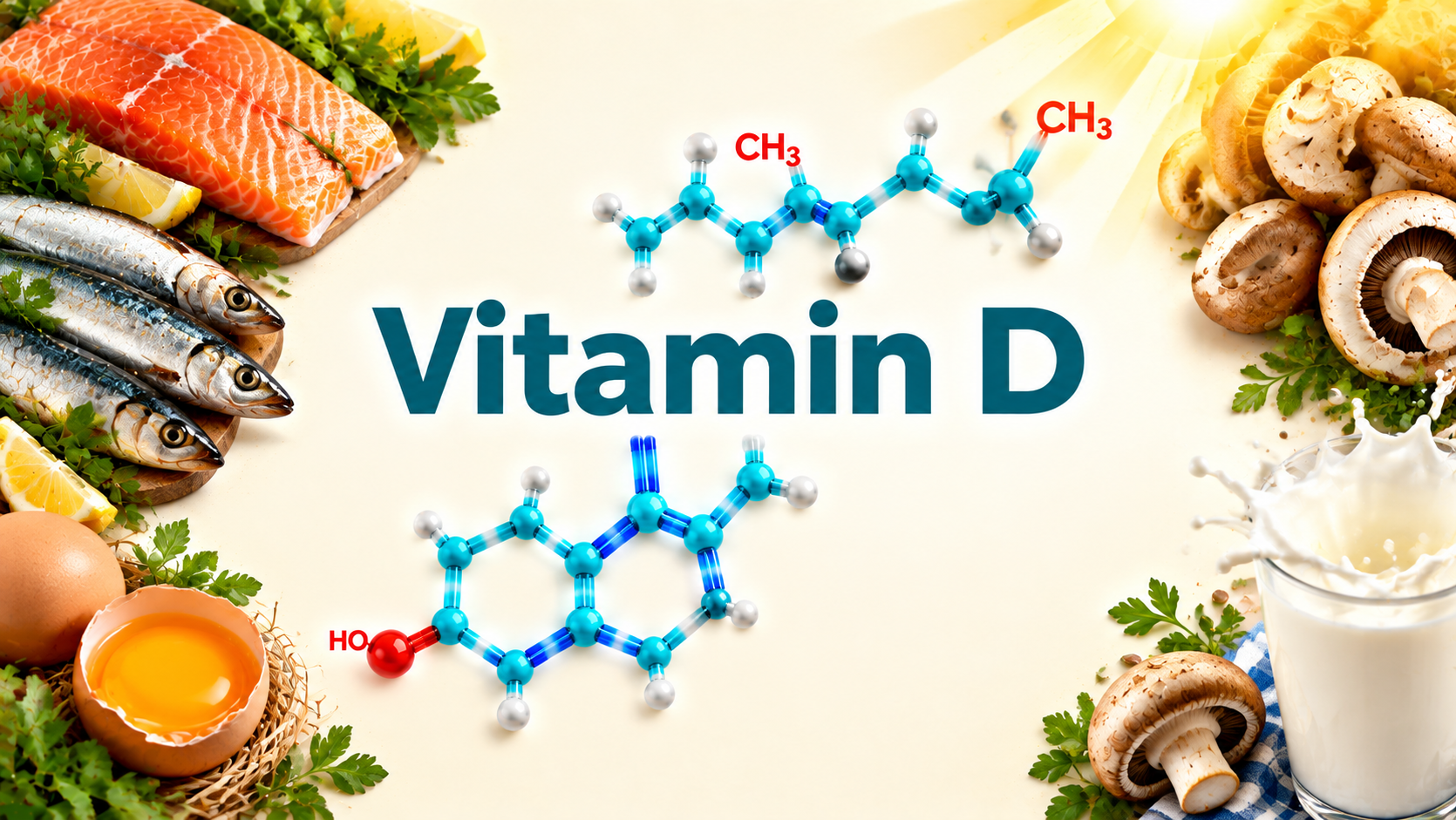
Vitamin D helps the body absorb calcium and supports bone, muscle and immune health. Unusually among vitamins, skin exposed to sunlight can produce it directly, though diet and fortified foods matter too, especially with limited sun exposure.
What is it?
Vitamin D is a fat-soluble vitamin that works more like a hormone. It comes in two main forms: vitamin D3 (cholecalciferol), made in the skin and found in animal foods, and vitamin D2 (ergocalciferol), found in UV-exposed mushrooms and some fortified foods. The liver and kidneys convert either form into the active hormone, calcitriol.
What it does
- Helps the gut absorb calcium and phosphorus, which are needed to build and maintain bones and teeth
- Supports normal muscle function
- Supports normal immune function
- Helps protect against rickets in children and osteomalacia and osteoporosis in adults
Food sources
Few foods naturally contain much vitamin D. The best sources are oily fish such as salmon, mackerel, sardines and herring, fish liver oils, egg yolks, UV-exposed mushrooms and some liver. Fortified foods — some milks, soy milks, breakfast cereals and fat spreads — add useful amounts.
Singapore food examples
- Salmon, mackerel and sardines — grilled, baked or steamed
- Egg yolks — soft-boiled eggs, kaya toast, omelettes
- Mushrooms (especially UV-exposed ones)
- Fortified milk, soy milk and breakfast cereals — check the label
- Tinned sardines and tuna
- Safe, sensible time outdoors — Singapore has strong sunlight year-round
How much do I need?
Singapore's RDA for adults is 2.5 micrograms (100 IU) a day, a lower figure than in many other countries because Singapore is tropical and has strong sunlight all year. For pregnant and breastfeeding women it is 10 micrograms (400 IU). See Singapore's age- and sex-specific Recommended Dietary Allowances (HealthHub) for the full tables.
For comparison, US and Canadian guidance is 15 micrograms (600 IU) a day for most adults and 20 micrograms (800 IU) after age 70, based on little to no sun exposure.
Low intake and deficiency
Severe deficiency causes rickets in children (soft, weak, bowed bones) and osteomalacia in adults (bone pain, muscle weakness). Milder low levels can contribute to bone loss and a higher risk of falls and fractures in older adults.
Despite the sunshine, low vitamin D levels are reported in Singapore, particularly among people who spend most of the day indoors, who cover their skin or use sunscreen, older adults, people with darker skin, people with obesity, and people with conditions that reduce fat absorption, such as coeliac disease, Crohn's disease or after weight-loss surgery. Breastfed infants need a supplement as breast milk contains little vitamin D.
Too much and safety
Too much vitamin D comes only from supplements, not from sun exposure or food. The tolerable upper limit for adults is 100 micrograms (4,000 IU) a day. Excess causes a build-up of calcium in the blood (hypercalcaemia), with nausea, vomiting, weakness, frequent urination and, over time, kidney damage and heart rhythm problems.
Some medicines — corticosteroids, thiazide diuretics, some weight-loss and anti-seizure drugs — interact with vitamin D. Talk to a doctor or pharmacist before taking high-dose supplements.
Absorption and bioavailability
Vitamin D is fat-soluble and is absorbed better with a meal that contains some fat. Magnesium is needed to activate it in the body.
Skin makes vitamin D when exposed to UVB light, but the amount depends on time of day, skin tone, age, clothing, sunscreen and body fat. Aim for sensible sun exposure and never burn — skin damage from sunburn is far worse than any vitamin D benefit. Vitamin D3 is generally better than D2 at raising and maintaining blood levels.
Connection to daily life
- Bone health: works with calcium to build and protect bones throughout life
- Healthy ageing: helps maintain muscle strength and reduce fall risk in older adults
- Exercise: outdoor exercise at sensible times can help, and weight-bearing activity supports bones — see Exercise
- Immunity: needed for normal immune function
- Related nutrients: see Vitamin K, Vitamin A and Fats and Oils
Food sources table
Amounts per serving from NIH data, ranked from highest to lowest.
Food | mcg per serving | IU per serving | % DV |
|---|---|---|---|
Cod liver oil, 1 tablespoon | 34.0 | 1,360 | 170 |
Trout (rainbow), farmed, cooked, 3 ounces | 16.2 | 645 | 81 |
Salmon (sockeye), cooked, 3 ounces | 14.2 | 570 | 71 |
Mushrooms, white, raw, sliced, exposed to UV light, ½ cup | 9.2 | 366 | 46 |
Milk, 2% milkfat, vitamin D fortified, 1 cup | 2.9 | 120 | 15 |
Soy, almond, and oat milks, fortified, 1 cup | 2.5–3.6 | 100–144 | 13–18 |
Ready-to-eat cereal, fortified with 10% of the DV, 1 serving | 2.0 | 80 | 10 |
Sardines (Atlantic), canned in oil, drained, 2 sardines | 1.2 | 46 | 6 |
Egg, 1 large, scrambled (yolk) | 1.1 | 44 | 6 |
Liver, beef, braised, 3 ounces | 1.0 | 42 | 5 |
Tuna fish (light), canned in water, drained, 3 ounces | 1.0 | 40 | 5 |
Cheese, cheddar, 1.5 ounce | 0.4 | 17 | 2 |
Chicken breast, roasted, 3 ounces | 0.1 | 4 | 1 |
Broccoli, raw, chopped, ½ cup | 0 | 0 | 0 |
Almonds, dry roasted, 1 ounce | 0 | 0 | 0 |
Sources: 1. NIH Office of Dietary Supplements — Vitamin D Fact Sheet for Health Professionals: https://ods.od.nih.gov/factsheets/VitaminD-HealthProfessional/ 2. HealthHub Singapore — Recommended Dietary Allowances: https://www.healthhub.sg/well-being-and-lifestyle/food-diet-and-nutrition/recommended_dietary_allowances 3. Health Promotion Board — Singapore Food Insights Database (SG FoodID): https://www.hpb.gov.sg/healthy-living/food-and-beverage/sgfoodid/ 4. FAO/INFOODS — Food composition tables and databases: https://www.fao.org/food-composition/tables-and-databases/en/ 5. NIH Office of Dietary Supplements — all fact sheets: https://ods.od.nih.gov/factsheets/list-all/ Food sources table: National Institutes of Health, Office of Dietary Supplements — Vitamin D Fact Sheet for Health Professionals, Table 3.
Comments
No comments yet.
Log in to leave a comment.