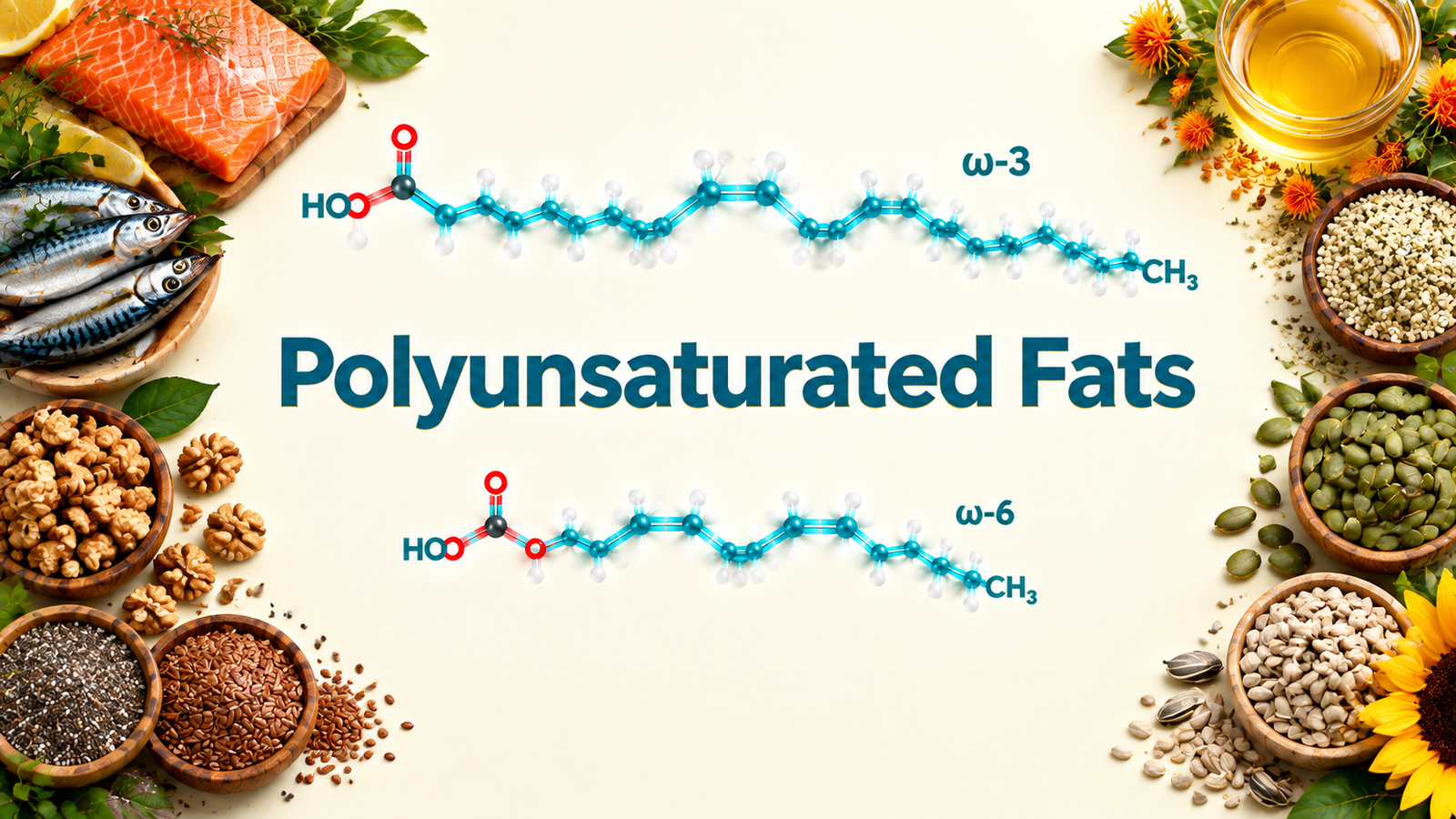
Polyunsaturated fats have two or more double bonds. They include the two essential fatty acids the body cannot make — omega-6 (linoleic acid) and omega-3 (alpha-linolenic acid) — along with the long-chain omega-3 fats EPA and DHA found in oily fish.
What is it?
There are two families. Omega-6 fats, mainly linoleic acid, come from vegetable oils, nuts and seeds. Omega-3 fats are alpha-linolenic acid (ALA) from plants such as flaxseed, chia, walnuts and canola oil, and EPA and DHA from oily fish and algae. Both families are used to make signalling molecules that affect inflammation, blood clotting and blood vessels.
See the pages for Omega-3 and Omega-6 for details.
What it does
- Supply the essential fatty acids needed for growth, skin and brain development
- Lower LDL cholesterol when they replace saturated fat
- Omega-3 fats lower triglycerides and are part of brain and eye membranes
- Provide vitamin E in many vegetable oils
Food sources
Sunflower, safflower, corn and soybean oil, walnuts, flaxseed, chia seeds, sunflower seeds, pumpkin seeds, and oily fish such as salmon, mackerel and sardines. Tofu and soybeans contain both families.
Singapore food examples
- Salmon, mackerel, sardines and ikan bilis
- Walnuts, flaxseed and chia seeds
- Sunflower and canola oil in cooking
- Tofu, tempeh and soya beans
- Pumpkin and sunflower seeds
How much do I need?
Singapore's RDA table does not list polyunsaturated fat. US National Academies guidance for adults is 5 to 10 percent of energy from omega-6 and 0.6 to 1.2 percent from omega-3. See Singapore's dietary guidelines for adults (HealthHub) for Singapore's overall fat guidance.
Low intake and deficiency
Too little of either essential fat causes dry, scaly skin and a rash, slow wound healing and poor growth in children, but this is rare. Many adults eat too little omega-3, especially with little fish in the diet.
Too much and safety
Polyunsaturated fats are good for the heart when they replace saturated fat. Very high intakes add many calories and, because they oxidise easily, repeated frying or poorly stored oils can produce harmful compounds. Very high doses of fish oil supplements can increase bleeding risk and, in some people, the risk of irregular heartbeat.
Absorption and bioavailability
Absorbed well in the small intestine. They are fragile: keep oils in dark, sealed bottles away from heat and use them within a few months, and avoid reusing frying oil many times. The body converts only a small share of plant omega-3 (ALA) into EPA and DHA, so eating fish or algae is the reliable way to get them.
Connection to daily life
- Heart health: replacing butter, ghee and fatty meat with plant oils, nuts and fish helps lower LDL
- Brain and eyes: omega-3 DHA is a major structural fat
- Healthy ageing and pregnancy: omega-3 intake is encouraged at both life stages
- Inflammation: balanced omega-3 and omega-6 intake supports healthy inflammation control
Sources: 1. National Academies of Sciences, Engineering, and Medicine — Dietary Reference Intakes for Energy, Carbohydrate, Fiber, Fat, Fatty Acids, Cholesterol, Protein, and Amino Acids (2005) 2. HealthHub Singapore — Recommended Dietary Allowances: https://www.healthhub.sg/well-being-and-lifestyle/food-diet-and-nutrition/recommended_dietary_allowances 3. HealthHub Singapore — Dietary guidelines for adults: https://www.healthhub.sg/well-being-and-lifestyle/food-diet-and-nutrition/dietary_guidelines_adults 4. Health Promotion Board — Singapore Food Insights Database (SG FoodID): https://www.hpb.gov.sg/healthy-living/food-and-beverage/sgfoodid/ 5. FAO/INFOODS — Food composition tables and databases: https://www.fao.org/food-composition/tables-and-databases/en/

Comments
No comments yet.
Log in to leave a comment.