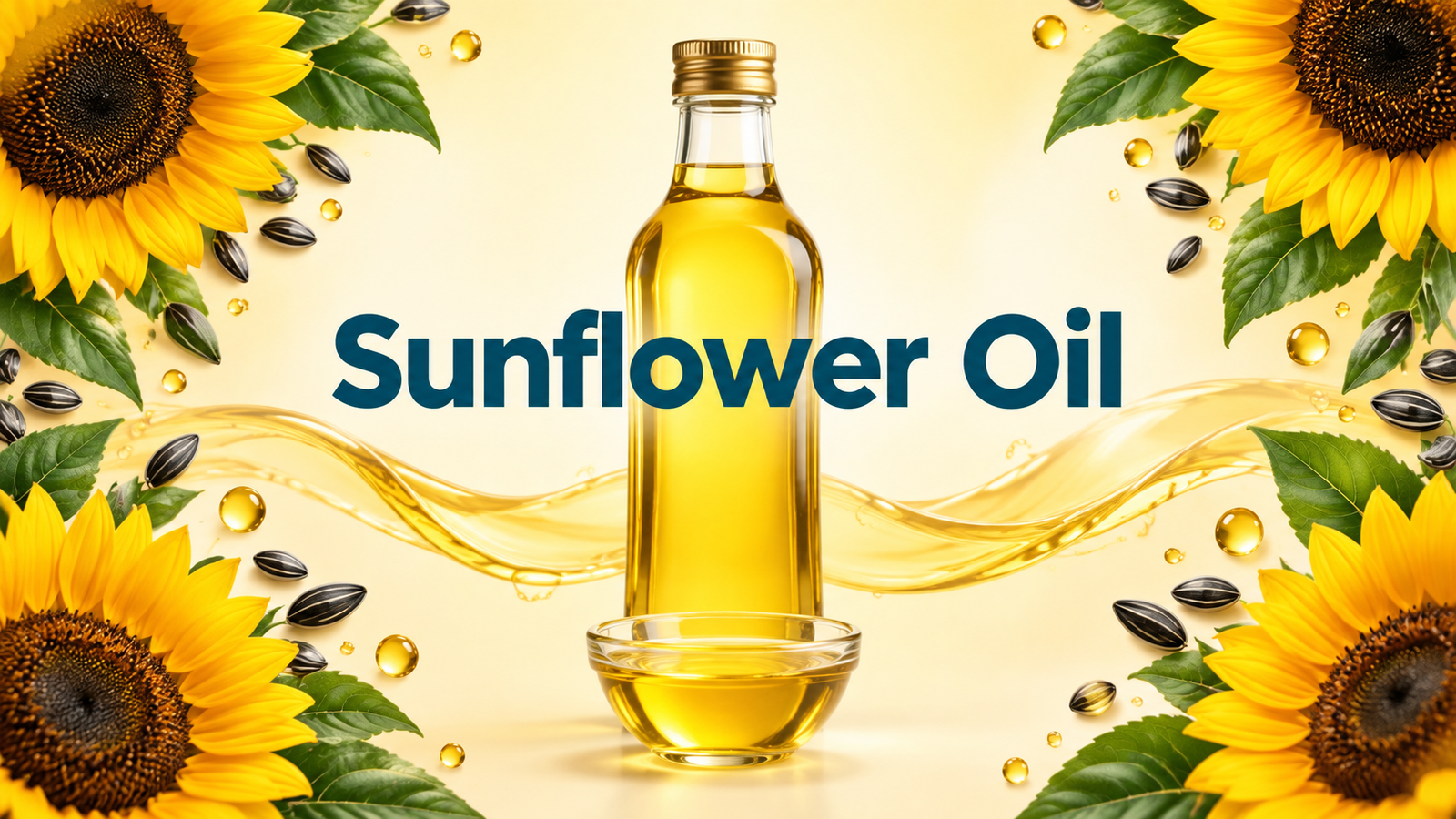
Name: Sunflower oil, pressed from sunflower seeds (Helianthus annuus). Like safflower, it is sold in nutritionally distinct types — high-linoleic, mid-oleic and high-oleic — worth checking on the label.
Description
The sunflower likely reached Europe through Spain before spreading to Russia, where selective breeding for higher oil content began around 1860, eventually raising the seed's oil content from roughly 28% to 50%. These high-oil Russian lines were introduced to the United States after the Second World War, and sunflower oil reached commodity trading status by 1967.
Intensive breeding through the 1970s produced a range of sunflower oil types with different fatty acid profiles: traditional high-linoleic sunflower (around 69% linoleic acid), mid-oleic, and high-oleic varieties (up to around 82% oleic acid) — each suited to different culinary and industrial uses.
Main nutrition value
Show all nutrients
Like all pure oils, sunflower oil is essentially 100% fat and around 884 kcal per 100g. Traditional high-linoleic sunflower oil is dominated by polyunsaturated omega-6 fat, while high-oleic sunflower oil is instead dominated by monounsaturated fat, closer to olive oil's profile. Standard sunflower oil has a high smoke point around 252–254°C (485–490°F); high-oleic versions are somewhat lower, around 445°F (229°C), but still well suited to frying.
How best to be consumed
Which type of sunflower oil suits your kitchen depends on what's on the label and what you're cooking.
- Check the label for “high-oleic” if you want a more heat-stable, monounsaturated-fat option.
- Use standard (high-linoleic) sunflower oil for baking and lower-heat cooking.
- Use high-oleic sunflower oil for frying and other high-heat methods, given its good stability.
- Store away from heat and light, particularly the high-linoleic type.
Overconsumption could cause…
Beyond the general calorie density of all oils, the two sunflower oil types carry slightly different considerations at high intake.
- A skewed omega-6 to omega-3 ratio if high-linoleic sunflower oil makes up most of your dietary fat.
- Excess calorie intake if used generously, since a tablespoon carries well over 100 kcal.
Wikipedia — Sunflower oil, used for breeding history and variety types: https://en.wikipedia.org/wiki/Sunflower_oil
Comments
No comments yet.
Log in to leave a comment.