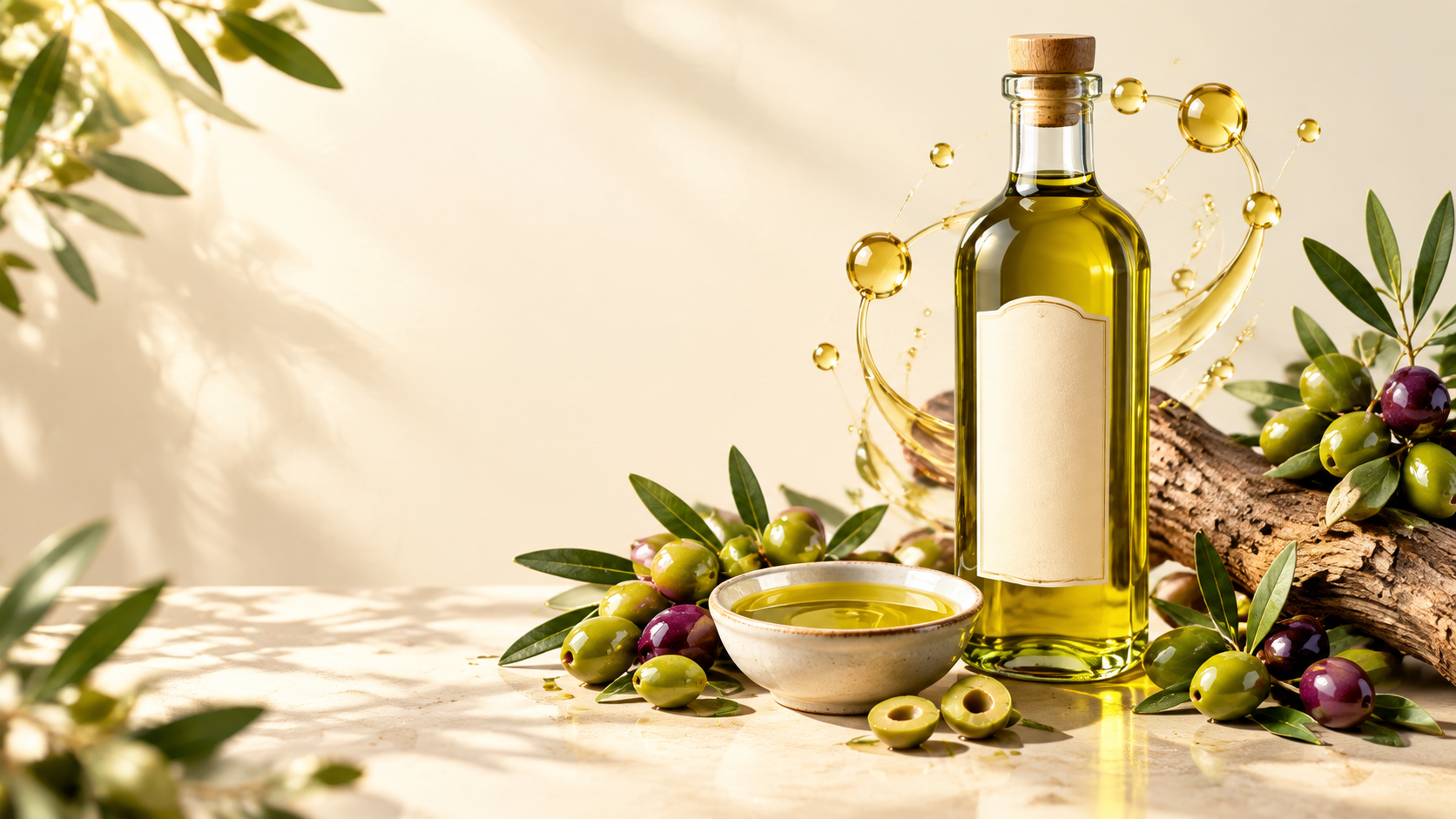
Name: Extra-virgin olive oil (often abbreviated EVOO) — the highest grade of olive oil, pressed from the fruit of the olive tree (Olea europaea). See the separate olive oil page for how the different grades compare.
Description
“Extra virgin” is not a marketing term but a legal and sensory classification: to earn it, the oil must be extracted purely by mechanical means, with no heat or chemical solvents, from olives free of significant defects, and must meet strict limits on free acidity and pass a taste panel evaluation. This mirrors the ancient Greek practice of cold-pressing olives with a mortar and pestle to preserve the oil's quality.
Olive oil production dates back roughly 8,000 years near the Sea of Galilee, with the Minoan civilisation on Crete domesticating the olive tree around 5,000 years ago. The Romans later spread olive cultivation across their Mediterranean empire, including to Spain, which today produces more olive oil than any other country.
Main nutrition value
Show all nutrients
Like all pure oils, extra-virgin olive oil is essentially 100% fat and around 884 kcal per 100g. Its fat is mostly monounsaturated (largely oleic acid), and because it isn't chemically refined, it retains polyphenols and other antioxidant plant compounds that other olive oil grades lose — these are part of what gives good extra-virgin oil its peppery, grassy taste and are the subject of ongoing research into olive oil's health effects.
How best to be consumed
Extra-virgin olive oil is best used where its flavour and polyphenol content can be appreciated, rather than for very high-heat cooking.
- Use raw or lightly warmed, in dressings, drizzled over finished dishes, or for dipping bread.
- Use for moderate-heat cooking such as sautéing — its smoke point is lower than refined oils but adequate for most everyday cooking.
- Store in a dark bottle away from heat and light, and use within a reasonable time after opening, since its beneficial compounds degrade with age and light exposure.
- Check the harvest date rather than relying on the best-before date alone, since fresher oil generally has more flavour and more intact polyphenols.
Overconsumption could cause…
Despite its health reputation, extra-virgin olive oil is still a concentrated fat, and the same general caution applies as to any oil.
- Excess calorie intake if used generously, since a tablespoon carries well over 100 kcal regardless of the oil's quality.
- No specific health risk beyond that of dietary fat in general, given its mostly monounsaturated profile and lack of trans fat.
Wikipedia — Olive oil, used for grading standards and polyphenol content: https://en.wikipedia.org/wiki/Olive_oil
Comments
No comments yet.
Log in to leave a comment.