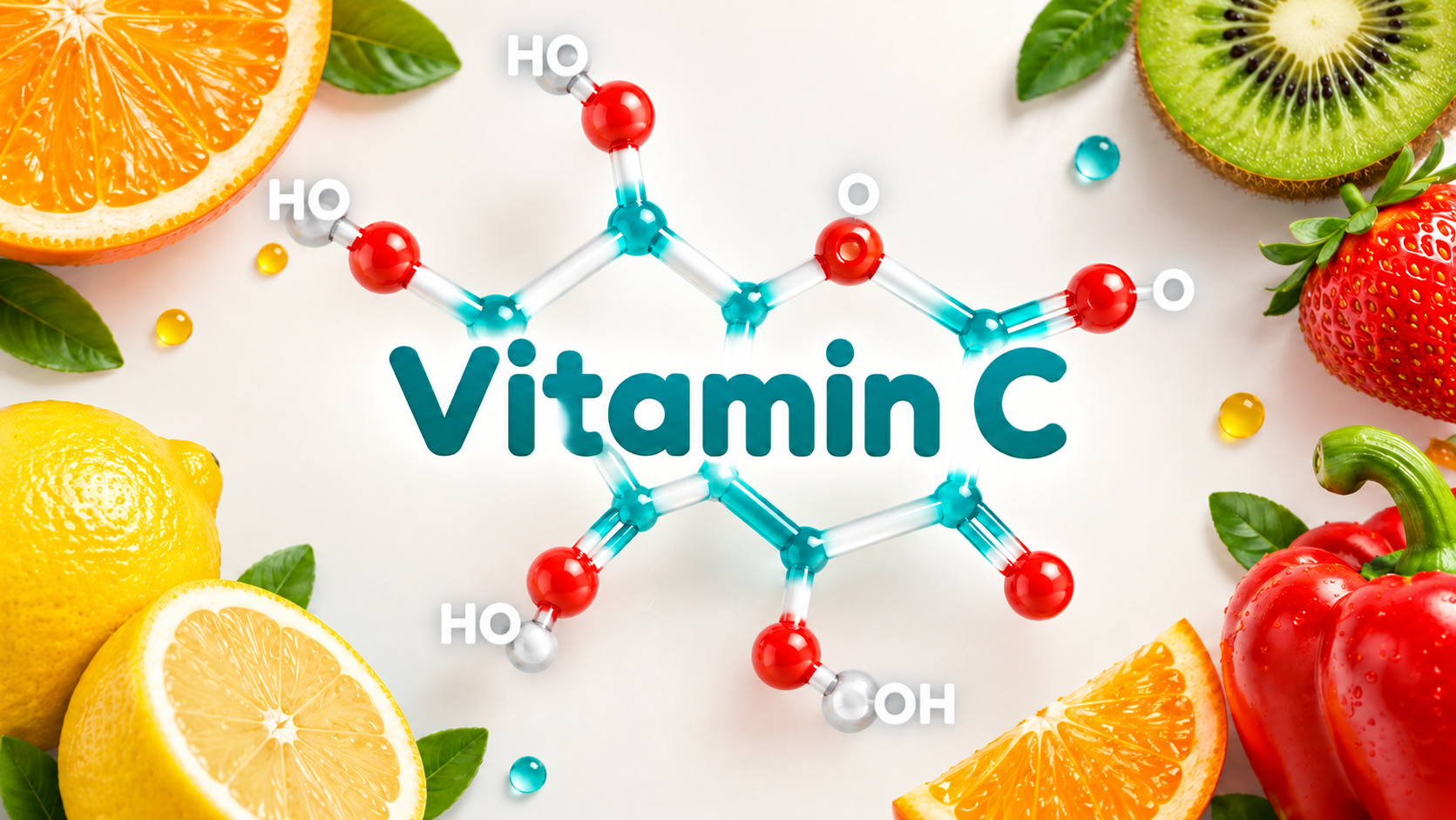
Vitamin C (ascorbic acid) is a water-soluble antioxidant the body can't produce on its own, so it has to come from food. It plays a role in immune function, wound healing and collagen production, and it helps the body absorb iron from plant foods.
What is it?
Humans, unlike most animals, cannot make vitamin C, so it must be eaten daily; the body stores only small amounts. In the body it acts as an antioxidant and as a helper in making collagen, the protein that holds skin, blood vessels, bones and cartilage together.
Prolonged, severe deficiency causes scurvy, which is rare where fresh produce is available year-round.
What it does
- Is needed to make collagen for skin, blood vessels, cartilage and bone, and for wound healing
- Acts as an antioxidant, protecting cells from damage caused by free radicals
- Helps the body absorb non-haem iron from plant foods
- Supports normal immune function
- Is involved in making some neurotransmitters, carnitine and hormones
Food sources
Citrus fruit, guava, kiwi, strawberries, papaya, red and yellow capsicum, broccoli, Brussels sprouts, kai lan, tomatoes and potatoes are rich in vitamin C. Fruit and vegetables provide most of it; animal foods supply almost none.
Singapore food examples
- Guava — one of the richest local fruits for vitamin C
- Pomelo, orange, calamansi (limau kasturi) and lemon
- Papaya, strawberries and kiwi
- Red and yellow capsicum in stir-fries and salads
- Kai lan, broccoli and tomatoes
- Calamansi squeezed over noodles, fish or sauces
How much do I need?
Singapore's adult RDA for vitamin C is 105 mg a day for men and 85 mg for women, rising to 100 mg in pregnancy and 135 mg while breastfeeding. Smokers need an extra 35 mg a day according to NIH guidance, because smoking increases vitamin C breakdown. See Singapore's age- and sex-specific Recommended Dietary Allowances (HealthHub) for the full tables.
Low intake and deficiency
Severe, long-term deficiency causes scurvy: tiredness, weakness, swollen and bleeding gums, easy bruising, small red or blue spots on the skin, joint pain, slow wound healing, corkscrew-shaped body hair and, if untreated, death. Early signs appear after about one month of very low intake (under 10 mg a day).
Scurvy is now rare, but higher-risk groups include people who smoke, people with very restricted diets (for example, "tea-and-toast" or very limited fruit and vegetables), people with alcohol or substance use disorders, people with severe malabsorption, and some older adults living alone.
Too much and safety
Vitamin C from food is safe. The tolerable upper limit for adults is 2,000 mg a day from all sources. Higher doses from supplements can cause diarrhoea, nausea, stomach cramps and bloating.
High-dose supplements may raise the risk of kidney stones, particularly in men. People with haemochromatosis (iron overload) should avoid high-dose vitamin C because it increases iron absorption, and people with kidney disease should check with their doctor.
Absorption and bioavailability
Between 70 and 90 percent of vitamin C is absorbed at moderate intakes (30 to 180 mg a day), but this falls below 50 percent at doses above 1 gram. Taking large supplement doses is therefore largely wasted — the extra is passed in urine.
Vitamin C is sensitive to heat, air and water: boiling can lose much of it into the cooking water. Eat fruit fresh, and steam or lightly cook vegetables. Eating vitamin C-rich foods with iron-rich plant foods (for example, capsicum with lentils or spinach) boosts iron absorption.
Connection to daily life
- Immunity: needed for immune cells to function, but taking extra does not prevent colds in most people — it may slightly shorten their duration
- Skin and wound healing: essential for collagen production
- Iron and energy: improves iron absorption, helping prevent iron-deficiency fatigue that affects exercise — see Exercise
- Healthy ageing: a diet rich in fruit and vegetables is linked with better health in later life
- Smoking: smokers have lower vitamin C levels, and quitting is one of the most effective health steps
Food sources table
Amounts per serving from NIH data, ranked from highest to lowest.
Food | mg per serving | % DV |
|---|---|---|
Red pepper, sweet, raw, ½ cup | 95 | 106 |
Orange juice, ¾ cup | 93 | 103 |
Orange, 1 medium | 70 | 78 |
Grapefruit juice, ¾ cup | 70 | 78 |
Kiwifruit, 1 medium | 64 | 71 |
Green pepper, sweet, raw, ½ cup | 60 | 67 |
Broccoli, cooked, ½ cup | 51 | 57 |
Strawberries, fresh, sliced, ½ cup | 49 | 54 |
Brussels sprouts, cooked, ½ cup | 48 | 53 |
Grapefruit, ½ medium | 39 | 43 |
Broccoli, raw, ½ cup | 39 | 43 |
Tomato juice, ¾ cup | 33 | 37 |
Cantaloupe, ½ cup | 29 | 32 |
Cabbage, cooked, ½ cup | 28 | 31 |
Cauliflower, raw, ½ cup | 26 | 29 |
Potato, baked, 1 medium | 17 | 19 |
Tomato, raw, 1 medium | 17 | 19 |
Spinach, cooked, ½ cup | 9 | 10 |
Green peas, frozen, cooked, ½ cup | 8 | 9 |
Sources: 1. NIH Office of Dietary Supplements — Vitamin C Fact Sheet for Health Professionals: https://ods.od.nih.gov/factsheets/VitaminC-HealthProfessional/ 2. HealthHub Singapore — Recommended Dietary Allowances: https://www.healthhub.sg/well-being-and-lifestyle/food-diet-and-nutrition/recommended_dietary_allowances 3. Health Promotion Board — Singapore Food Insights Database (SG FoodID): https://www.hpb.gov.sg/healthy-living/food-and-beverage/sgfoodid/ 4. FAO/INFOODS — Food composition tables and databases: https://www.fao.org/food-composition/tables-and-databases/en/ 5. NIH Office of Dietary Supplements — all fact sheets: https://ods.od.nih.gov/factsheets/list-all/ Food sources table: National Institutes of Health, Office of Dietary Supplements — Vitamin C Fact Sheet for Health Professionals, Table 2.
Comments
No comments yet.
Log in to leave a comment.