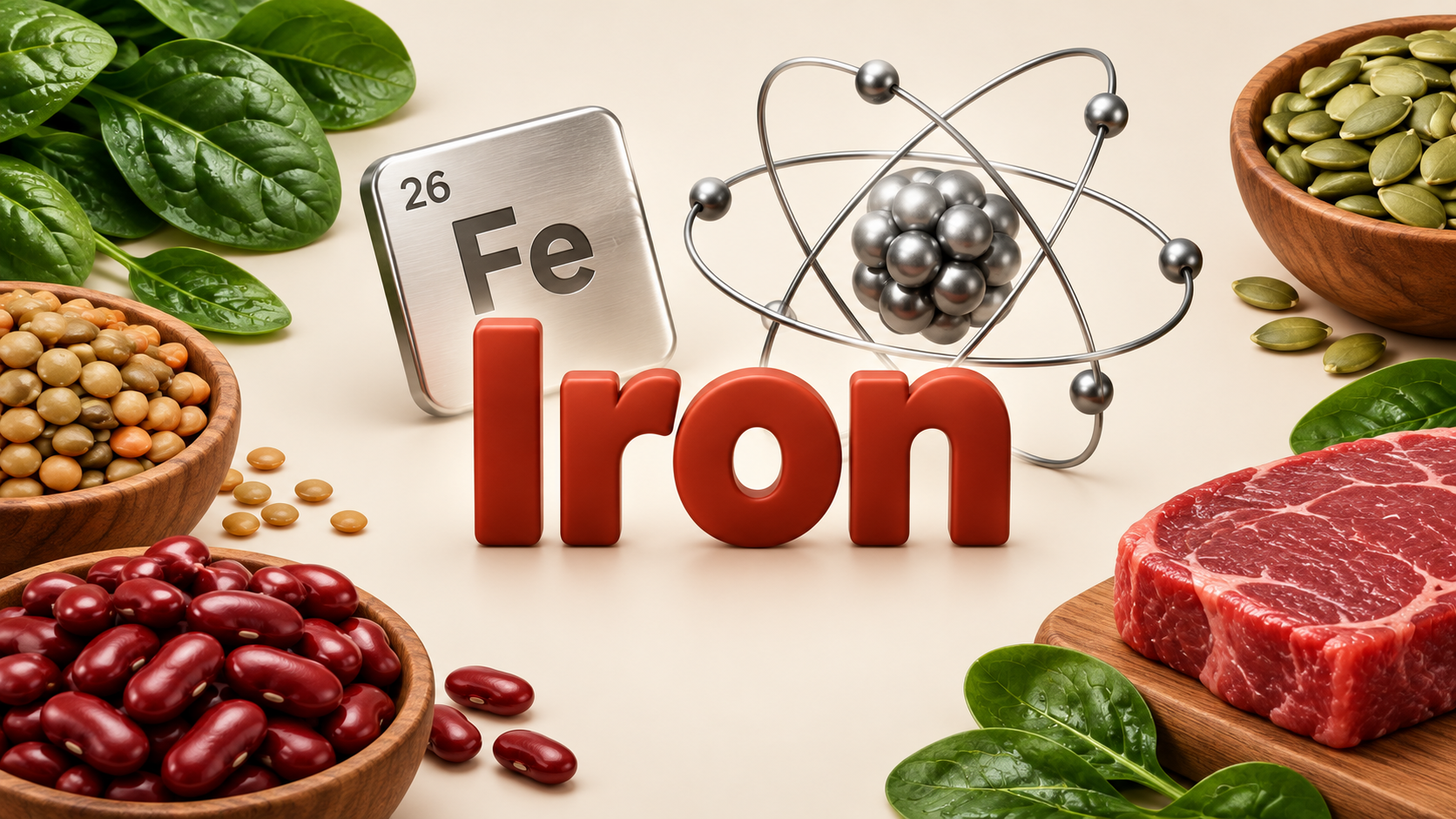
Iron carries oxygen in red blood cells and muscles and is needed for energy, growth and immunity. It is the most common nutrient shortfall in the world, especially among women who menstruate, pregnant women, vegetarians and endurance athletes.
What is it?
Iron is a trace mineral and the central part of haemoglobin, which carries oxygen in the blood, and myoglobin, which stores oxygen in muscle. Dietary iron comes in two forms: haem iron (from meat, fish and poultry), which is well absorbed, and non-haem iron (from plant foods, eggs, dairy and fortified foods), which is absorbed less easily.
What it does
- Carries oxygen in haemoglobin and myoglobin
- Is needed to make energy in cells
- Supports growth, brain development and immune function
- Is needed to make some hormones and connective tissue
Food sources
Haem iron: beef, lamb, liver, dark chicken meat and shellfish such as clams, oysters and cockles. Non-haem iron: legumes (lentils, chickpeas, beans), tofu, dark leafy greens, nuts and seeds, wholegrains, dried fruit and iron-fortified cereals. The table at the end of this page lists amounts per serving.
Singapore food examples
- Blood cockles (kerang) — a rich, traditional iron source, cooked thoroughly
- Lean beef and mutton in curries and stir-fries; chicken thigh and liver
- Tofu and tempeh, dhal, chickpeas and kidney beans
- Kai lan, spinach and kang kong with a vitamin C food
- Dried fruit such as dates and apricots
- Iron-fortified cereals and malted drinks — check the label
How much do I need?
Singapore's RDA for iron is 8 mg a day for adult men and for women aged 60 and over, but 18 mg a day for women aged 18 to under 60 because of menstrual blood loss. Pregnancy needs 27 mg. Breastfeeding needs 9 mg in the first six months and 18 mg after. See Singapore's age- and sex-specific Recommended Dietary Allowances (HealthHub) for the full table.
Low intake and deficiency
Low iron stores can progress to iron-deficiency anaemia, causing tiredness, weakness, pale skin, breathlessness, dizziness, headaches, cold hands and feet, brittle nails, a sore tongue, restless legs, craving for ice or non-food items (pica) and poorer concentration, immunity and exercise performance.
Higher risk: women with heavy periods, pregnant women, infants and toddlers, vegetarians and vegans, frequent blood donors, endurance athletes, people with coeliac or inflammatory bowel disease, and people with gut bleeding. See a doctor before treating suspected iron deficiency with supplements, since the cause needs to be found.
Too much and safety
The upper limit for adults is 45 mg a day from supplements and food. Iron supplements commonly cause constipation, nausea and stomach pain. Too much iron over time can build up, particularly in people with haemochromatosis, an inherited condition, and damage the liver, heart and pancreas.
Iron overdose is a leading cause of poisoning in young children — keep supplements and iron-fortified vitamins locked away. Men and post-menopausal women should not take iron supplements without a clear reason.
Absorption and bioavailability
Haem iron is absorbed at about 15 to 35 percent; non-haem iron at only about 2 to 20 percent. Vitamin C, meat, fish and poultry increase non-haem iron absorption. Tea and coffee tannins, calcium, phytates in wholegrains and legumes, and some medicines (antacids, proton pump inhibitors) reduce it.
Practical tips: have a vitamin C food (citrus, capsicum, guava) with plant iron, drink tea and coffee between meals rather than with them, and soak or ferment beans and grains. Cooking in an iron pan adds a little iron to acidic foods.
Connection to daily life
- Energy and exercise: iron deficiency reduces endurance and recovery — see Exercise
- Sleep: low iron is linked to restless legs syndrome, which disturbs sleep — see Sleep
- Pregnancy and healthy ageing: needs change across life stages
- Works with vitamin C, vitamin B12, folate and copper to make healthy red blood cells
Food sources table
Amounts per serving from NIH data, ranked from highest to lowest.
Food | mg per serving | % DV |
|---|---|---|
Breakfast cereals, fortified with 100% of the DV, 1 serving | 18 | 100 |
Oysters, eastern, cooked with moist heat, 3 ounces | 8 | 44 |
White beans, canned, 1 cup | 8 | 44 |
Beef liver, pan fried, 3 ounces | 5 | 28 |
Lentils, boiled and drained, ½ cup | 3 | 17 |
Spinach, boiled and drained, ½ cup | 3 | 17 |
Tofu, firm, ½ cup | 3 | 17 |
Chocolate, dark, 45%–69% cacao, 1 ounce | 2 | 11 |
Kidney beans, canned, ½ cup | 2 | 11 |
Sardines, Atlantic, canned in oil, drained, 3 ounces | 2 | 11 |
Chickpeas, boiled and drained, ½ cup | 2 | 11 |
Tomatoes, canned, stewed, ½ cup | 2 | 11 |
Beef, braised bottom round, fat trimmed, 3 ounces | 2 | 11 |
Potato, baked, flesh and skin, 1 medium | 2 | 11 |
Cashew nuts, oil roasted, 1 ounce (18 nuts) | 2 | 11 |
Green peas, boiled, ½ cup | 1 | 6 |
Chicken, roasted, meat and skin, 3 ounces | 1 | 6 |
Bread, whole wheat, 1 slice | 1 | 6 |
Tuna, light, canned in water, 3 ounces | 1 | 6 |
Broccoli, boiled and drained, ½ cup | 1 | 6 |
Egg, hard boiled, 1 large | 1 | 6 |
Rice, brown, long or medium grain, cooked, 1 cup | 1 | 6 |
Cheese, cheddar, 1.5 ounces | 0 | 0 |
Milk, 1 cup | 0 | 0 |
Sources: 1. NIH Office of Dietary Supplements — Iron Fact Sheet for Health Professionals: https://ods.od.nih.gov/factsheets/Iron-HealthProfessional/ 2. HealthHub Singapore — Recommended Dietary Allowances: https://www.healthhub.sg/well-being-and-lifestyle/food-diet-and-nutrition/recommended_dietary_allowances 3. Health Promotion Board — Singapore Food Insights Database (SG FoodID): https://www.hpb.gov.sg/healthy-living/food-and-beverage/sgfoodid/ 4. FAO/INFOODS — Food composition tables and databases: https://www.fao.org/food-composition/tables-and-databases/en/ 5. NIH Office of Dietary Supplements — all fact sheets: https://ods.od.nih.gov/factsheets/list-all/ Food sources table: National Institutes of Health, Office of Dietary Supplements — Iron Fact Sheet for Health Professionals, Table 2.
Comments
No comments yet.
Log in to leave a comment.