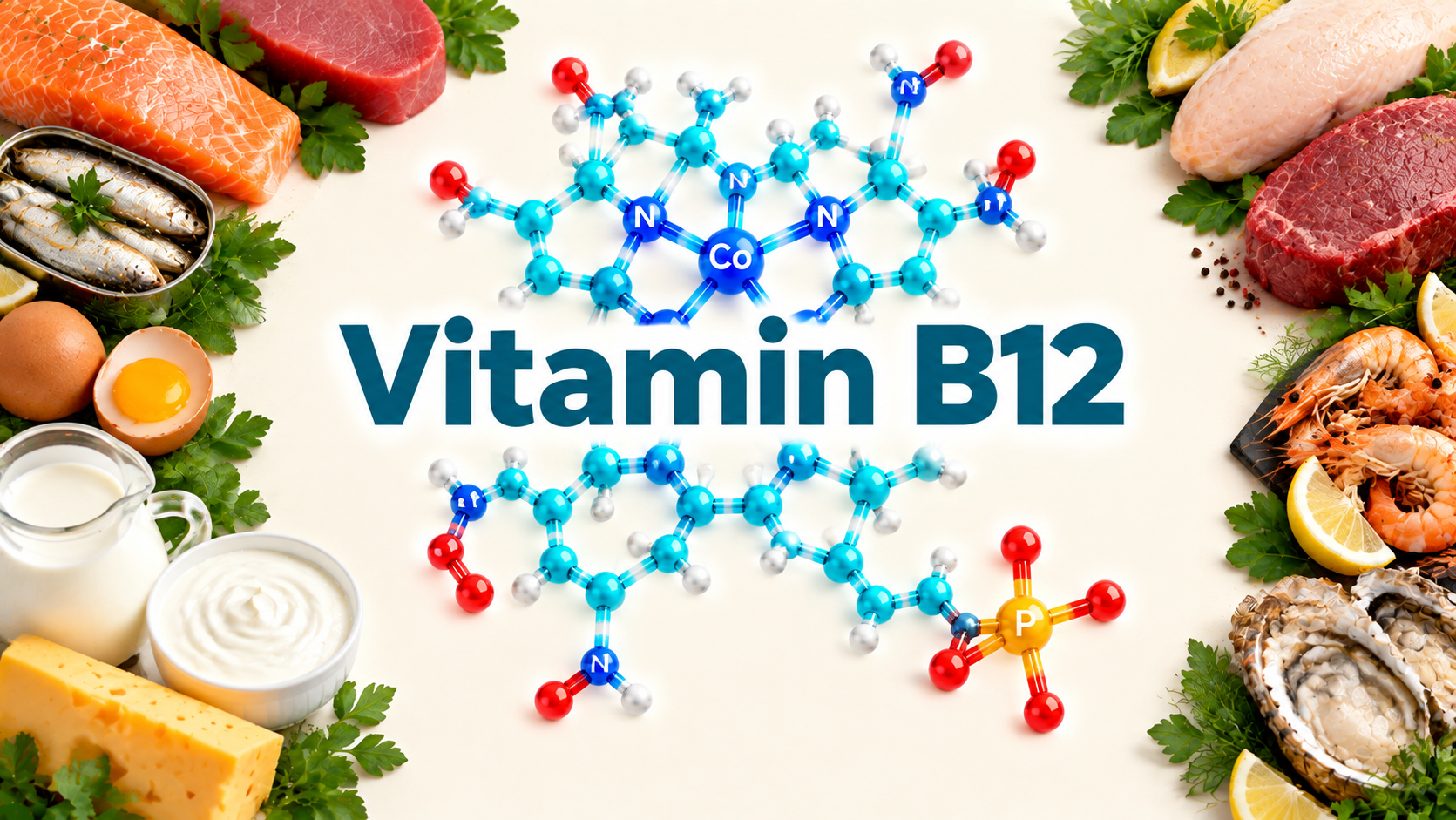
Vitamin B12 (cobalamin) is essential for nerve function, red blood cell formation and DNA synthesis. It is found almost exclusively in animal foods, which is why fortified foods or supplements are often recommended for people who eat a fully plant-based diet, and why older adults may need extra attention to absorption.
What is it?
Vitamin B12 is a water-soluble vitamin and the only one that contains a mineral (cobalt), hence the name cobalamin. The main forms are cyanocobalamin (common in supplements), methylcobalamin and adenosylcobalamin. B12 is made only by microorganisms; animals get it from their diet and gut bacteria, which is why it appears in animal foods.
What it does
- Helps form healthy red blood cells
- Keeps the nervous system working, including the protective coating (myelin) around nerves
- Is needed to make DNA in every cell
- Works with folate to process homocysteine and make methionine
Food sources
Clams, beef and other meat, liver, fish (sardines, salmon, tuna, trout), milk, yoghurt and cheese and eggs provide B12. Plant foods do not naturally contain it, but fortified nutritional yeast, fortified plant milks and some fortified cereals do.
Singapore food examples
- Fish — steamed, grilled, in sliced fish soup and fish head curry
- Chicken, beef and pork in everyday dishes
- Eggs — kaya toast with soft-boiled eggs, congee, omelette
- Milk, yoghurt and cheese
- Clams, cockles and other shellfish
- Fortified soy milk and cereals for vegetarians and vegans — check the label for B12
How much do I need?
Singapore's RDA for adults is 2.4 micrograms a day, rising to 2.6 micrograms in pregnancy and 2.8 micrograms while breastfeeding. Children need less (for example 1.1 micrograms at ages 3 to 6). See Singapore's age- and sex-specific Recommended Dietary Allowances (HealthHub) for the full tables.
Low intake and deficiency
Deficiency can cause tiredness, weakness, pale or yellowish skin, a sore smooth tongue, mouth ulcers, breathlessness, a type of anaemia (megaloblastic), numbness or tingling in the hands and feet, balance problems, memory loss, and low mood. Nerve damage can become permanent if deficiency is left untreated, so early diagnosis matters.
Higher risk groups include adults over 50 (with reduced stomach acid), people who are vegetarian or vegan and do not use fortified foods or supplements — many people in Singapore follow plant-based diets for religious, health or environmental reasons — people with pernicious anaemia or other digestive conditions, people who have had stomach or intestinal surgery, and people on long-term metformin or acid-reducing medicines (proton pump inhibitors, H2 blockers).
Too much and safety
No upper limit has been set for B12, because it has low toxicity and the body excretes excess in urine. B12 is generally safe, but high doses can occasionally cause acne or rosacea-like skin reactions. If you have kidney disease, ask your doctor about the best form and dose.
Absorption and bioavailability
B12 in food is bound to protein and needs stomach acid and enzymes to be released. It then binds to a protein made in the stomach called intrinsic factor, which is needed to absorb it in the last part of the small intestine. Low stomach acid, a lack of intrinsic factor (pernicious anaemia) or gut surgery can all cut absorption.
Synthetic B12 in supplements and fortified foods is not bound to protein, so it does not need stomach acid to be released, making it a reliable choice for older adults and people with low stomach acid. Very large doses can also be absorbed by passive diffusion — about 1 percent — even without intrinsic factor.
Connection to daily life
- Energy and exercise: low B12 causes tiredness and anaemia that makes exercise harder — see Exercise
- Healthy ageing: absorption falls with age, and low B12 can affect memory and balance
- Plant-based eating: a supplement or fortified food is advised for vegans and often for vegetarians
- Heart and brain health: works with folate and vitamin B6 to control homocysteine
Food sources table
Amounts per serving from NIH data, ranked from highest to lowest.
Food | mcg per serving | % DV |
|---|---|---|
Beef liver, cooked, pan fried, 3 ounces | 70.7 | 2,944 |
Clams (without shells), cooked, 3 ounces | 17 | 708 |
Oysters, eastern, wild, cooked, 3 ounces | 14.9 | 621 |
Nutritional yeast, fortified, about ¼ cup | 8.3–24 | 346–1,000 |
Salmon, Atlantic, cooked, 3 ounces | 2.6 | 108 |
Tuna, light, canned in water, 3 ounces | 2.5 | 104 |
Beef, ground, 85% lean/15% fat, pan browned, 3 ounces | 2.4 | 100 |
Milk, 2% milkfat, 1 cup | 1.3 | 54 |
Yogurt, plain, fat free, 6-ounce container | 1.0 | 43 |
Breakfast cereals, fortified with 25% of the DV, 1 serving | 0.6 | 25 |
Cheese, cheddar, 1½ ounces | 0.5 | 19 |
Egg, whole, cooked, 1 large | 0.5 | 19 |
Turkey, breast meat, roasted, 3 ounces | 0.3 | 14 |
Tempeh, ½ cup | 0.1 | 3 |
Banana, 1 medium | 0.0 | 0 |
Bread, whole wheat, 1 slice | 0.0 | 0 |
Strawberries, raw, halved, ½ cup | 0.0 | 0 |
Beans, kidney, boiled, ½ cup | 0.0 | 0 |
Spinach, boiled, drained, ½ cup | 0.0 | 0 |
Sources: 1. NIH Office of Dietary Supplements — Vitamin B12 Fact Sheet for Health Professionals: https://ods.od.nih.gov/factsheets/VitaminB12-HealthProfessional/ 2. HealthHub Singapore — Recommended Dietary Allowances: https://www.healthhub.sg/well-being-and-lifestyle/food-diet-and-nutrition/recommended_dietary_allowances 3. Health Promotion Board — Singapore Food Insights Database (SG FoodID): https://www.hpb.gov.sg/healthy-living/food-and-beverage/sgfoodid/ 4. FAO/INFOODS — Food composition tables and databases: https://www.fao.org/food-composition/tables-and-databases/en/ 5. NIH Office of Dietary Supplements — all fact sheets: https://ods.od.nih.gov/factsheets/list-all/ Food sources table: National Institutes of Health, Office of Dietary Supplements — Vitamin B12 Fact Sheet for Health Professionals, Table 2.
Comments
No comments yet.
Log in to leave a comment.