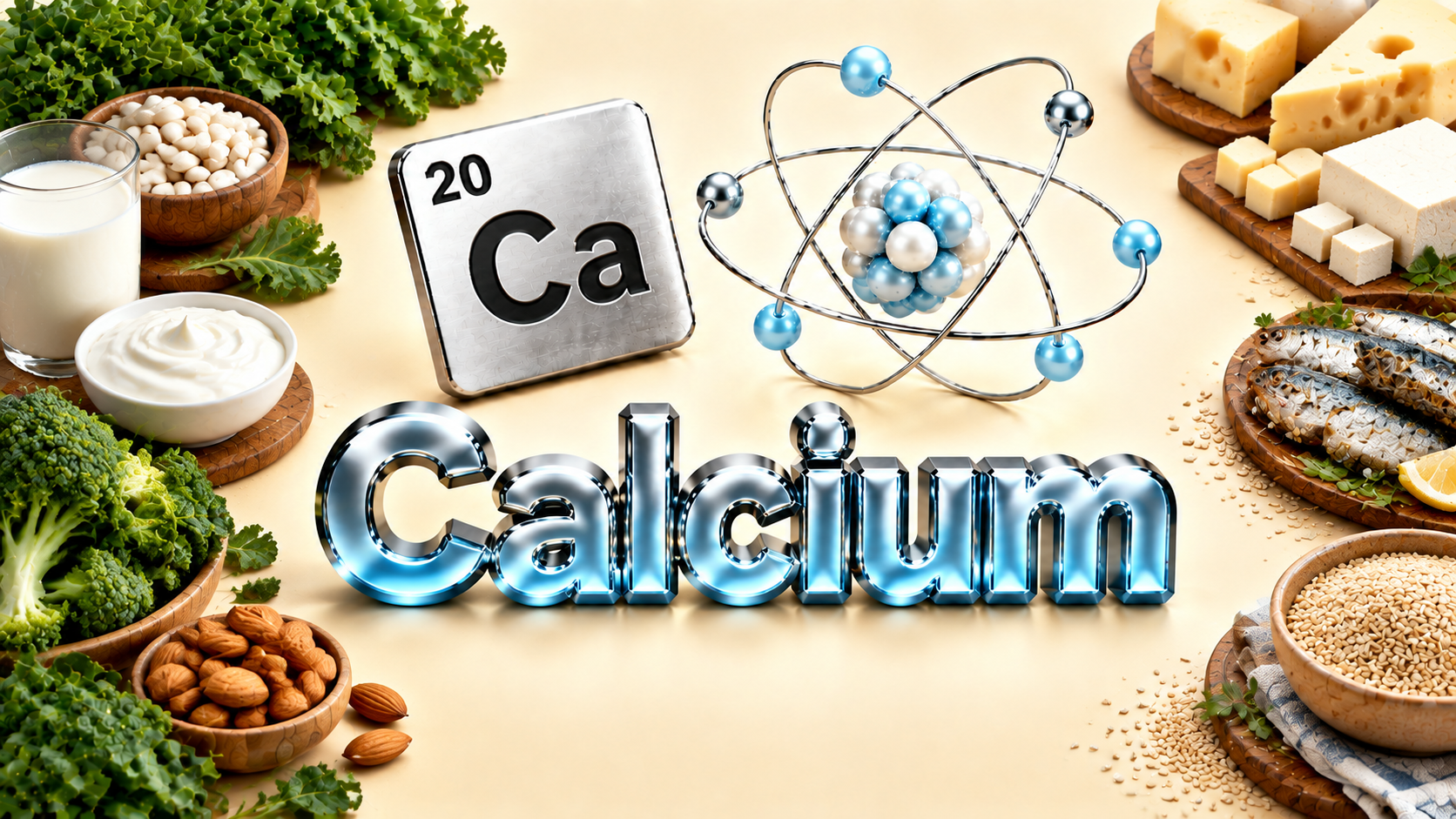
Calcium is the most abundant mineral in the body. About 99 percent of it is stored in bones and teeth, where it gives them strength; the rest helps muscles contract, nerves send signals and blood clot.
What is it?
Calcium is a major mineral. The body keeps blood calcium in a tight range and, if intake is too low, takes it from bone — so a long-term shortfall shows up as weaker bones rather than low blood levels.
What it does
- Builds and maintains bones and teeth
- Lets muscles, including the heart, contract and relax
- Helps nerves carry messages
- Is needed for normal blood clotting and for releasing hormones and enzymes
Food sources
Milk, yoghurt and cheese are the main sources in many diets. Others include tofu set with calcium sulphate, calcium-fortified soy milk and other plant drinks, canned fish eaten with the bones (sardines, ikan bilis), kai lan, bok choy, broccoli, almonds, sesame seeds and tempeh. Spinach is high in calcium but also high in oxalate, which blocks most of it.
Singapore food examples
- Milk, yoghurt and cheese; fortified soy milk for dairy-free eating
- Calcium-set tofu (check the label) and tau kwa
- Ikan bilis and small fish eaten whole, tinned sardines
- Kai lan, chye sim and bok choy
- Tempeh, sesame seeds and almonds
- Calcium-fortified cereals and drinks — check the label
How much do I need?
Singapore's RDA for calcium is 800 mg a day for adults aged 19 to 50 and 1,000 mg a day from 51 and during pregnancy and breastfeeding; 1,000 mg for ages 10 to 18, and lower amounts for younger children. See Singapore's age- and sex-specific Recommended Dietary Allowances (HealthHub) for the full table.
Low intake and deficiency
Over years, low calcium intake leads to low bone density and raises the risk of osteoporosis and fractures. In children, severe shortage with low vitamin D causes rickets. Very low blood calcium (usually from illness, not diet) causes numbness and tingling, muscle cramps and, in severe cases, seizures and heart rhythm problems.
Higher risk: women after menopause, older adults, people who avoid dairy without replacing it, people with lactose intolerance or coeliac disease, and people who take long-term steroid medicines.
Too much and safety
The upper limit for adults is 2,500 mg a day from food and supplements for ages 19 to 50, and 2,000 mg a day after 50. Too much, mostly from supplements, can cause constipation, bloating and kidney stones, and may interfere with iron and zinc absorption.
Calcium can reduce the absorption of some medicines, including thyroid hormone, certain antibiotics and bisphosphonates for osteoporosis — take them at different times, as advised by your pharmacist.
Absorption and bioavailability
Adults absorb roughly 30 percent of the calcium they eat, less when taking large amounts at once, so spread intake over the day (no more than about 500 mg at a time from supplements). Vitamin D is needed for absorption — see Vitamin D.
Oxalates (spinach, rhubarb) and phytates (wholegrain bran, legumes) bind calcium. Calcium carbonate supplements are best taken with food; calcium citrate can be taken at any time.
Connection to daily life
- Bone health: peak bone mass is built in the first three decades, so calcium matters most in childhood, adolescence and young adulthood
- Exercise: weight-bearing and resistance exercise helps bones use calcium — see Exercise
- Healthy ageing: calcium, vitamin D and vitamin K work together to slow bone loss
- Salt: a high-sodium diet increases calcium loss in urine — see Sodium
Sources: 1. NIH Office of Dietary Supplements — Calcium Fact Sheet for Health Professionals: https://ods.od.nih.gov/factsheets/Calcium-HealthProfessional/ 2. HealthHub Singapore — Recommended Dietary Allowances: https://www.healthhub.sg/well-being-and-lifestyle/food-diet-and-nutrition/recommended_dietary_allowances 3. Health Promotion Board — Singapore Food Insights Database (SG FoodID): https://www.hpb.gov.sg/healthy-living/food-and-beverage/sgfoodid/ 4. FAO/INFOODS — Food composition tables and databases: https://www.fao.org/food-composition/tables-and-databases/en/ 5. NIH Office of Dietary Supplements — all fact sheets: https://ods.od.nih.gov/factsheets/list-all/
Comments
No comments yet.
Log in to leave a comment.