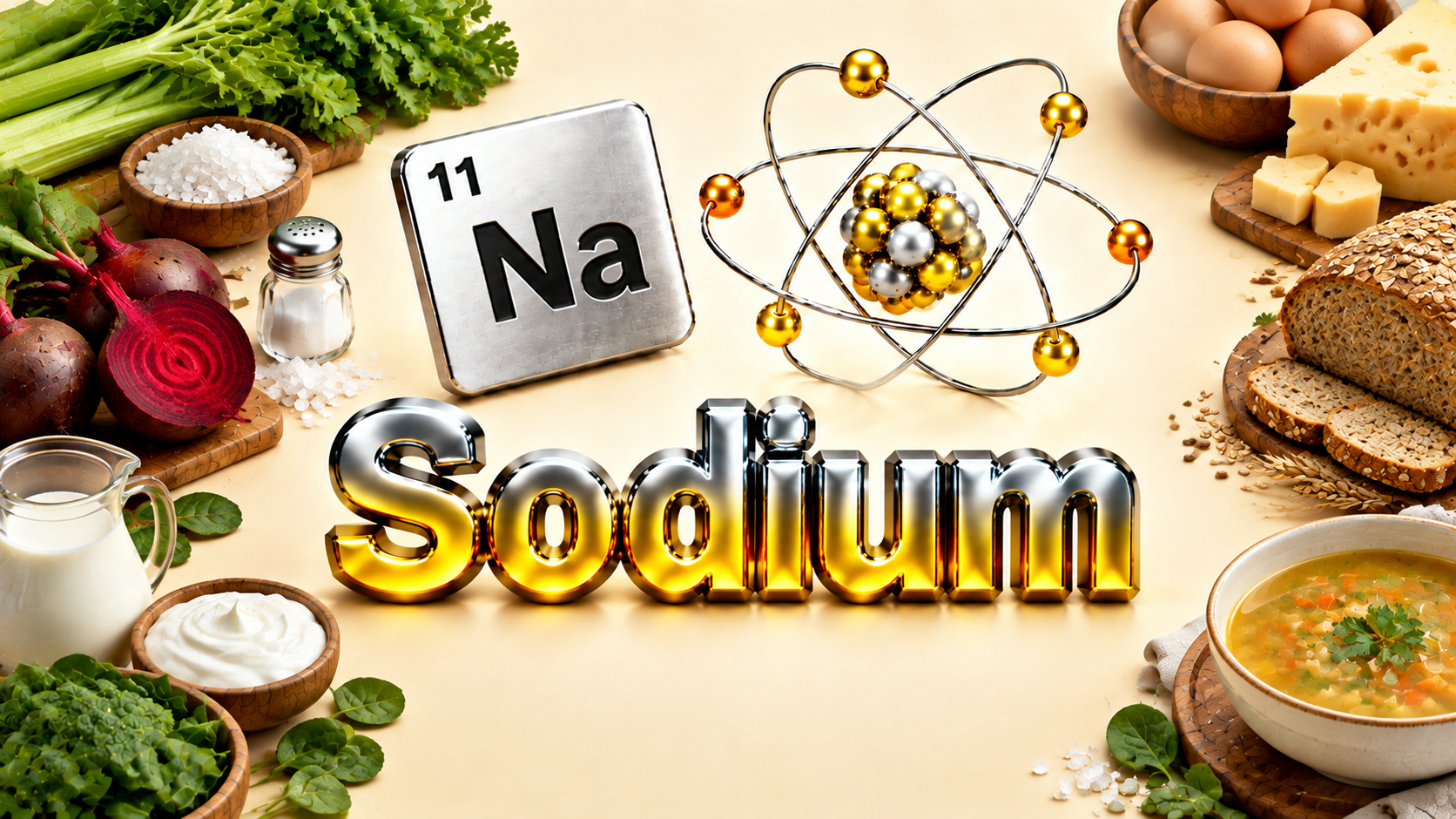
Sodium is an essential electrolyte involved in fluid balance and nerve function, but most modern diets provide far more than the body needs — largely from processed and restaurant food rather than the salt shaker. Consistently high intake is linked to higher blood pressure in many people.
What is it?
Sodium is a major mineral and the main positively charged particle in the fluid outside cells. Table salt is about 40 percent sodium and 60 percent chloride by weight, and one level teaspoon of salt (about 5 g) contains roughly 2,000 mg of sodium. Food labels in Singapore usually list sodium in mg.
What it does
- Keeps the right amount of fluid in and around cells and in the blood
- Helps nerves send signals and muscles contract
- Helps the body absorb some nutrients, such as glucose and amino acids, in the gut
- Helps maintain blood volume and blood pressure
Food sources
Salt added at the table or in cooking, soy sauce, oyster and fish sauces, stock cubes, instant noodles, canned foods, processed and preserved meats, salted fish, pickles, bread, cheese, snack foods and sauces. Fresh vegetables, fruit, plain meat, fish and eggs contain little.
Singapore food examples
- Soup and gravy in hawker dishes — laksa, curry noodles, bak chor mee soup
- Sauces and condiments: soy sauce, oyster sauce, sambal, chilli and dipping sauces
- Instant noodles and flavour packets, stock cubes
- Salted fish, salted egg, preserved vegetables and fermented bean paste
- Chicken rice (rice seasoning and sauces), char kway teow, fried rice
- Healthier options: leave soup, ask for sauces on the side, choose the Healthier Choice symbol, and add lemon, herbs and spices for flavour
How much do I need?
Singapore's dietary guidelines recommend limiting salt to less than 5 g a day, equal to about 2,000 mg of sodium — see Singapore's dietary guidelines for adults (HealthHub). Surveys in Singapore show most adults eat well above this, around 9 g of salt a day on average.
For comparison, the US National Academies set an Adequate Intake of 1,500 mg a day for adults and advise reducing intake if above 2,300 mg a day.
Low intake and deficiency
Low sodium in the diet is very rare, because it is in nearly all foods. Low blood sodium (hyponatraemia) usually comes from drinking too much water, such as in endurance events, from some medicines (water pills, antidepressants), or from illness, and causes headache, nausea, confusion, muscle cramps and, in severe cases, seizures.
Too much and safety
Long-term high sodium intake raises blood pressure in many people, which raises the risk of stroke, heart disease and kidney disease. High salt intake is also linked to stomach cancer, kidney stones and loss of calcium from bone.
People with high blood pressure, heart failure, kidney or liver disease may be given a lower sodium target by their doctor.
Absorption and bioavailability
Sodium is absorbed almost completely in the gut, and the kidneys remove the excess in urine. Eating more potassium helps the body excrete sodium. Sweating in hot weather loses sodium, but most people replace it easily through food.
Tips: taste before adding salt or sauce, use herbs, garlic, lime and spices, drink less of the soup, rinse canned foods, and choose products with lower sodium on the label.
Connection to daily life
- Heart health: cutting sodium is one of the most effective ways to lower blood pressure
- Eating out: hawker and restaurant food is often the biggest source — small changes add up
- Exercise and heat: prolonged heavy sweating loses sodium; most people do not need extra beyond a normal diet — see Exercise
- Healthy ageing: taste fades with age, which can lead to adding more salt — flavour with herbs and spices
Sources: 1. National Academies of Sciences, Engineering, and Medicine — Dietary Reference Intakes for Sodium and Potassium (2019) 2. HealthHub Singapore — Recommended Dietary Allowances: https://www.healthhub.sg/well-being-and-lifestyle/food-diet-and-nutrition/recommended_dietary_allowances 3. HealthHub Singapore — Dietary guidelines for adults: https://www.healthhub.sg/well-being-and-lifestyle/food-diet-and-nutrition/dietary_guidelines_adults 4. Health Promotion Board — Singapore Food Insights Database (SG FoodID): https://www.hpb.gov.sg/healthy-living/food-and-beverage/sgfoodid/ 5. FAO/INFOODS — Food composition tables and databases: https://www.fao.org/food-composition/tables-and-databases/en/
Comments
No comments yet.
Log in to leave a comment.