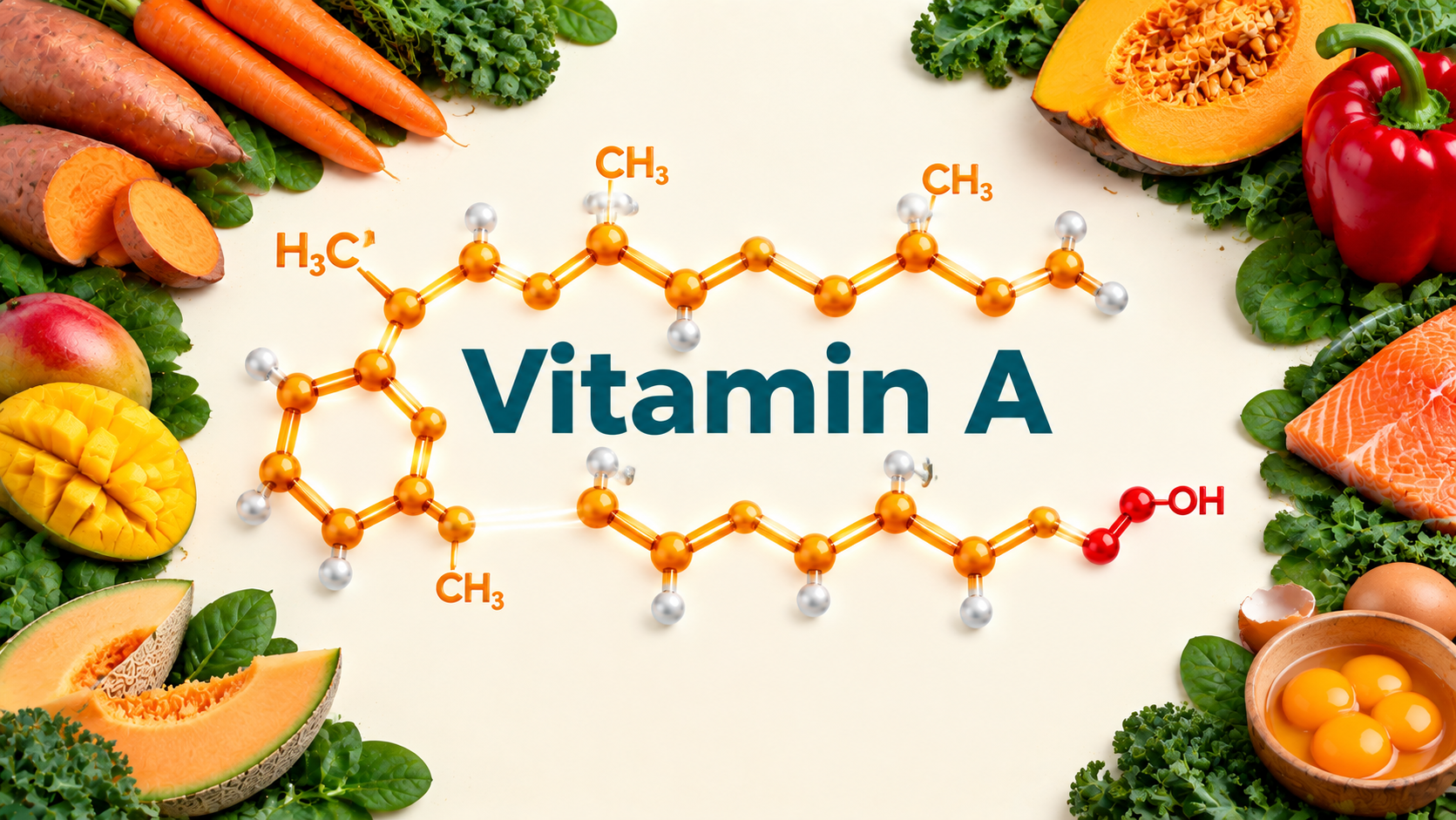
Vitamin A is a fat-soluble essential nutrient that supports normal vision, immune function, growth, reproduction, and the maintenance of healthy skin and body tissues. It comes from animal foods as preformed vitamin A and from plant foods as provitamin A carotenoids, which the body can convert into vitamin A.
What is it?
Vitamin A is a group of related compounds rather than one single substance. The main active forms include retinol, retinal (retinaldehyde), and retinoic acid. Plant foods mainly supply carotenoids such as beta-carotene, which the body can convert to vitamin A as needed.
Preformed vitamin A (retinol and retinyl esters) comes from liver, fish, eggs, milk, cheese and fortified foods, and is already active. Provitamin A carotenoids come from dark-green leafy vegetables, carrots, sweet potato, pumpkin, mango and papaya.
What it does
- Supports normal vision, including the eye's ability to adapt in low light
- Helps maintain immune defences and supports protection against infections
- Supports normal growth, development, and repair of body tissues
- Helps maintain healthy skin and the linings of the lungs, digestive tract and other organs
- Supports reproductive health and normal cell development
Food sources
Vitamin A is found in both animal and plant foods. A food-first approach built around a variety of colourful fruit and vegetables, leafy greens, eggs, dairy and fish will usually provide enough for most people. The table at the end of this page lists the richest sources per serving.
Singapore food examples
- Kai lan, spinach and chye sim (beta-carotene) — add to soup, stir-fries or fish soup
- Carrot and pumpkin (beta-carotene) — include in soups, porridge, curry or roasted vegetables
- Sweet potato (beta-carotene) — a snack or carbohydrate choice
- Papaya and mango (beta-carotene) — eat as fruit after meals or with breakfast
- Egg yolk (retinol) — add eggs to meals, sandwiches or congee
- Milk, yoghurt and cheese (retinol, sometimes fortified) — choose unsweetened or lower-sugar options
- Fish (retinol) — include regularly as part of a balanced eating pattern
- Liver (very high preformed vitamin A) — eat occasionally rather than frequently
How much do I need?
Singapore guidance lists an adult Recommended Dietary Allowance (RDA) of 750 micrograms of retinol equivalents (RE) per day for vitamin A, rising to 1,200 micrograms during breastfeeding. See Singapore's age- and sex-specific Recommended Dietary Allowances (HealthHub) for the full tables. Individual needs vary by age, sex, pregnancy, breastfeeding status, health condition and overall dietary pattern.
Vitamin A values may appear as micrograms RAE (retinol activity equivalents) or retinol equivalents, because different forms are converted at different rates. The NIH uses RAE because beta-carotene from food is converted less efficiently than preformed retinol.
Low intake and deficiency
Deficiency can impair vision, especially in low light, and may contribute to dry eyes, reduced immune function and increased susceptibility to infections. Severe and prolonged deficiency can cause serious eye damage.
Deficiency is generally uncommon in developed settings such as Singapore because vitamin A is available in many everyday foods. Risk is higher in people with very restricted diets or conditions that reduce fat digestion and nutrient absorption.
Too much and safety
Vitamin A from colourful vegetables and fruit is generally not a concern, because carotenoids are converted by the body as needed. The larger risk comes from frequent high intakes of preformed vitamin A from liver, high-dose supplements, or several supplements taken together.
For adults, the tolerable upper intake level for preformed vitamin A is 3,000 micrograms per day from food, drinks and supplements. This limit does not apply to beta-carotene and other provitamin A carotenoids.
People who are pregnant, planning pregnancy, or taking acne medicines or other retinoid-based treatments should seek professional medical or pharmacy advice before using vitamin A supplements.
Absorption and bioavailability
Vitamin A is fat-soluble, so it is absorbed better as part of a meal containing some fat. Pair stir-fried kai lan with tofu, add nuts or seeds to a carrot salad, or eat papaya alongside yoghurt.
Cooking and blending can sometimes make carotenoids in vegetables more available, but a varied intake of raw and cooked fruit and vegetables remains a practical approach.
Connection to daily life
- Immunity: helps maintain the body's protective barriers and supports normal immune function
- Eye health: essential for normal vision, particularly adaptation to dim light
- Healthy ageing: colourful plant foods that provide carotenoids also contribute fibre and other beneficial plant compounds
- Food variety: eating dark-green, orange, yellow and red plant foods supports vitamin A intake and overall dietary diversity
- Related nutrients: see Vitamin D, Vitamin E and Fats and Oils
Food sources table
Amounts per serving from NIH data, ranked from highest to lowest.
Food | mcg RAE per serving | % DV |
|---|---|---|
Beef liver, pan fried, 3 ounces | 6,582 | 731 |
Sweet potato, baked in skin, 1 whole | 1,403 | 156 |
Spinach, frozen, boiled, ½ cup | 573 | 64 |
Pumpkin pie, commercially prepared, 1 piece | 488 | 54 |
Carrots, raw, ½ cup | 459 | 51 |
Herring, Atlantic, pickled, 3 ounces | 219 | 24 |
Ice cream, French vanilla, soft serve, ⅔ cup | 185 | 21 |
Milk, skim, with added vitamin A and vitamin D, 1 cup | 149 | 17 |
Cantaloupe, raw, ½ cup | 135 | 15 |
Cheese, ricotta, part skim, ½ cup | 133 | 15 |
Peppers, sweet, red, raw, ½ cup | 117 | 13 |
Mangos, raw, 1 whole | 112 | 12 |
Breakfast cereals, fortified with 10% of the DV, 1 serving | 90 | 10 |
Egg, hard boiled, 1 large | 75 | 8 |
Black-eyed peas (cowpeas), boiled, 1 cup | 66 | 7 |
Apricots, dried, sulfured, 5 apricots | 63 | 7 |
Broccoli, boiled, ½ cup | 60 | 7 |
Salmon, sockeye, cooked, 3 ounces | 59 | 7 |
Tomato juice, canned, ¾ cup | 42 | 5 |
Yogurt, plain, low fat, 1 cup | 32 | 4 |
Tuna, light, canned in oil, drained, 3 ounces | 20 | 2 |
Baked beans, canned, plain or vegetarian, 1 cup | 13 | 1 |
Summer squash, all varieties, boiled, ½ cup | 10 | 1 |
Chicken, breast meat and skin, roasted, ½ breast | 5 | 1 |
Pistachio nuts, dry roasted, 1 ounce | 4 | 0 |
Sources: 1. NIH Office of Dietary Supplements — Vitamin A and Carotenoids Fact Sheet for Health Professionals: https://ods.od.nih.gov/factsheets/VitaminA-HealthProfessional/ 2. NIH Office of Dietary Supplements — Vitamin A and Carotenoids, consumer fact sheet: https://ods.od.nih.gov/factsheets/VitaminA-Consumer/ 3. HealthXchange — Vitamin A: why we need it: https://www.healthxchange.sg/food-nutrition/vitamins/vitamin-a-why-we-need-it 4. Harvard T.H. Chan School of Public Health, The Nutrition Source — Vitamin A: https://nutritionsource.hsph.harvard.edu/vitamin-a/ 5. HealthHub — Nutrition Hub, eat more: https://www.healthhub.sg/programmes/nutrition-hub/eat-more 6. HealthHub Singapore — Recommended Dietary Allowances: https://www.healthhub.sg/well-being-and-lifestyle/food-diet-and-nutrition/recommended_dietary_allowances 7. Health Promotion Board — Singapore Food Insights Database (SG FoodID): https://www.hpb.gov.sg/healthy-living/food-and-beverage/sgfoodid/ 8. FAO/INFOODS — Food composition tables and databases: https://www.fao.org/food-composition/tables-and-databases/en/ 9. NIH Office of Dietary Supplements — all fact sheets: https://ods.od.nih.gov/factsheets/list-all/ Food sources table: National Institutes of Health, Office of Dietary Supplements — Vitamin A and Carotenoids Fact Sheet for Health Professionals, Table 2.
Comments
No comments yet.
Log in to leave a comment.