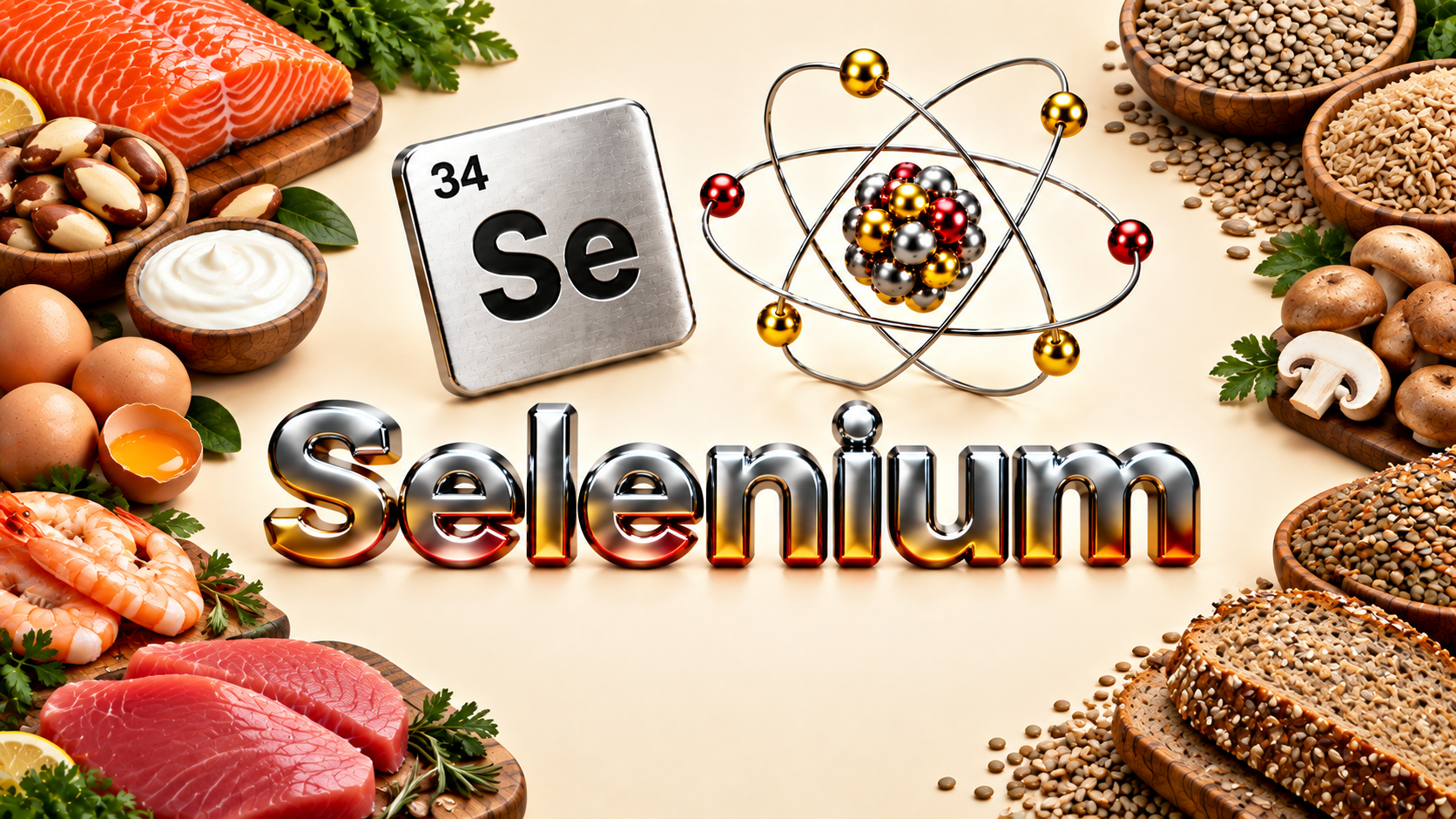
Selenium is a trace mineral that acts as an antioxidant, supports the immune system and helps the thyroid make active hormone. Seafood, meat, eggs and Brazil nuts are rich sources, and the range between enough and too much is narrow.
What is it?
Selenium is built into about 25 selenoproteins in the body, including glutathione peroxidases (antioxidant enzymes) and iodothyronine deiodinases (which activate thyroid hormone). The selenium in plant foods depends on soil levels, which vary widely between regions.
What it does
- Is part of antioxidant enzymes that protect cells from damage
- Helps the thyroid make and activate thyroid hormone
- Supports immune function and reproduction
- Is needed to make DNA
Food sources
Brazil nuts (extremely rich — one nut can supply more than a day's needs), seafood such as tuna, prawns and sardines, meat and poultry, eggs, dairy and wholegrains are the main sources.
Singapore food examples
- Fish — tuna, mackerel, sardines, snapper — and prawns
- Chicken, pork and beef
- Eggs
- Brown rice and wholegrain bread
- Brazil nuts, in small amounts only
- Mushrooms
How much do I need?
Singapore's RDA table on HealthHub does not list this nutrient, so the figures below come from US and Canadian reference intakes (Dietary Reference Intakes). Use them as a guide, and see Singapore's age- and sex-specific Recommended Dietary Allowances (HealthHub) for the nutrients Singapore does list.
The US National Academies' RDA for selenium is 55 micrograms a day for adults, 60 micrograms in pregnancy and 70 micrograms while breastfeeding.
Low intake and deficiency
Selenium deficiency is rare where varied and imported foods are eaten. It is seen in regions with selenium-poor soil and diets built on local foods, where it causes Keshan disease (a heart muscle disorder) and Kashin-Beck disease (a joint disorder), especially with other stresses such as low iodine. Low selenium can also affect the thyroid and male fertility.
Too much and safety
The upper limit for adults is 400 micrograms a day from all sources. Too much selenium (selenosis) causes garlic-smelling breath, a metallic taste, hair and nail brittleness and loss, skin rash, nausea, diarrhoea, tiredness and nerve damage. Eating more than a few Brazil nuts a day regularly, or taking high-dose supplements, can exceed this.
Large trials have not shown that selenium supplements prevent cancer or heart disease in people who are not deficient, and some have raised concerns, so do not take them without a reason.
Absorption and bioavailability
Selenium in food is well absorbed, over 50 percent, and organic forms such as selenomethionine (found in foods and yeast) are absorbed at about 90 percent. Vitamin E and sulfur-containing compounds can influence how it is used. Cooking loses little unless food is boiled with the water discarded.
Connection to daily life
- Thyroid and energy: works with iodine to keep the thyroid working
- Immunity and healthy ageing: part of the antioxidant defences; food is the best source
- Supplements: more is not better; check the label
Food sources table
Amounts per serving from NIH data, ranked from highest to lowest.
Food | mcg per serving | % DV |
|---|---|---|
Brazil nuts, 1 ounce (6–8 nuts) | 544 | 989 |
Tuna, yellowfin, cooked, 3 ounces | 92 | 167 |
Sardines, canned in oil, drained, 3 ounces | 45 | 82 |
Shrimp, cooked, 3 ounces | 42 | 76 |
Pork chop, bone-in, broiled, 3 ounces | 37 | 67 |
Beef steak, bottom round, roasted, 3 ounces | 37 | 67 |
Spaghetti, cooked, 1 cup | 33 | 60 |
Beef liver, pan fried, 3 ounces | 28 | 51 |
Turkey, boneless, roasted, 3 ounces | 26 | 47 |
Ham, roasted, 3 ounces | 24 | 44 |
Cod, Pacific, cooked, 3 ounces | 24 | 44 |
Chicken, light meat, roasted, 3 ounces | 22 | 40 |
Cottage cheese, 1% milkfat, 1 cup | 20 | 36 |
Beef, ground, 25% fat, broiled, 3 ounces | 18 | 33 |
Egg, hard-boiled, 1 large | 15 | 27 |
Baked beans, canned, 1 cup | 13 | 24 |
Oatmeal, regular and quick, cooked with water, 1 cup | 13 | 24 |
Mushrooms, portabella, grilled, ½ cup | 13 | 24 |
Rice, brown, long-grain, cooked, 1 cup | 12 | 22 |
Bread, whole-wheat, 1 slice | 8 | 15 |
Yogurt, plain, low fat, 1 cup | 8 | 15 |
Milk, 1% fat, 1 cup | 6 | 11 |
Lentils, boiled, 1 cup | 6 | 11 |
Spinach, frozen, boiled, ½ cup | 5 | 9 |
Sources: 1. NIH Office of Dietary Supplements — Selenium Fact Sheet for Health Professionals: https://ods.od.nih.gov/factsheets/Selenium-HealthProfessional/ 2. HealthHub Singapore — Recommended Dietary Allowances: https://www.healthhub.sg/well-being-and-lifestyle/food-diet-and-nutrition/recommended_dietary_allowances 3. Health Promotion Board — Singapore Food Insights Database (SG FoodID): https://www.hpb.gov.sg/healthy-living/food-and-beverage/sgfoodid/ 4. FAO/INFOODS — Food composition tables and databases: https://www.fao.org/food-composition/tables-and-databases/en/ 5. NIH Office of Dietary Supplements — all fact sheets: https://ods.od.nih.gov/factsheets/list-all/ Food sources table: National Institutes of Health, Office of Dietary Supplements — Selenium Fact Sheet for Health Professionals, Table 2.
Comments
No comments yet.
Log in to leave a comment.