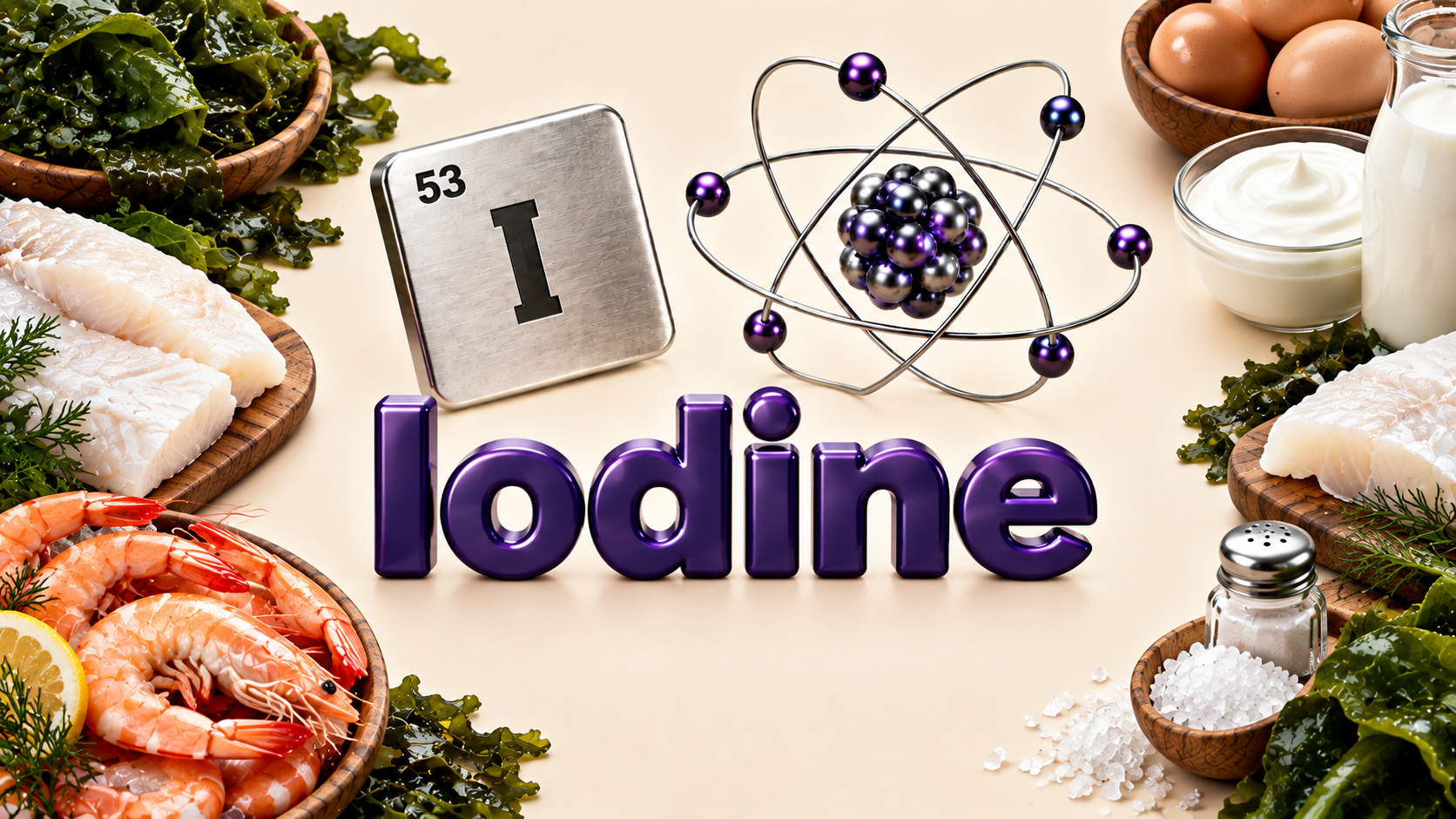
Iodine is a trace mineral the thyroid gland needs to make hormones that control metabolism, growth and, in babies, brain development. Seafood, seaweed, dairy and eggs are the main sources, and needs rise during pregnancy and breastfeeding.
What is it?
Iodine is an essential component of thyroid hormones T3 and T4. The body cannot make it, and the amount in food depends on the iodine in soil, sea water and animal feed. About 70 to 80 percent of the body's iodine is in the thyroid.
What it does
- Makes thyroid hormones that regulate metabolism and body temperature
- Supports growth and development, including the brain and nervous system of the fetus and infant
- Supports normal heart rate and energy levels
Food sources
Seaweed (kelp, kombu and nori), cod and other fish, shellfish, dairy products, eggs and iodised salt are the main sources. Seaweed iodine content varies widely, from modest in nori to extremely high in kelp and kombu.
Singapore food examples
- Fish and prawns in everyday dishes
- Seaweed — nori, wakame and kombu in soups and sushi
- Milk, yoghurt and cheese
- Eggs
- Iodised salt, where available — check the label
How much do I need?
Singapore's RDA table on HealthHub does not list this nutrient, so the figures below come from US and Canadian reference intakes (Dietary Reference Intakes). Use them as a guide, and see Singapore's age- and sex-specific Recommended Dietary Allowances (HealthHub) for the nutrients Singapore does list.
The US National Academies' RDA for iodine is 150 micrograms a day for adults, 220 micrograms in pregnancy and 290 micrograms while breastfeeding.
Low intake and deficiency
Low iodine can cause an enlarged thyroid (goitre), an underactive thyroid (hypothyroidism) with tiredness, weight gain, feeling cold and dry skin, and, in pregnancy, impaired brain development and growth of the baby, miscarriage and stillbirth. Mild deficiency during pregnancy may reduce a child's IQ.
Higher risk groups are pregnant and breastfeeding women, people who avoid dairy, eggs and seafood (including vegans), and people who use non-iodised salts exclusively. If you are pregnant or planning pregnancy, talk to your doctor about iodine.
Too much and safety
The upper limit for adults is 1,100 micrograms a day. Too much iodine can cause the thyroid to over- or underperform, goitre, and thyroid inflammation. Kelp and kombu products and some supplements can contain very large amounts — avoid eating them daily, and check labels on seaweed supplements.
People with thyroid disease, and those taking thyroid medicine, amiodarone or lithium, should check with their doctor before changing iodine intake.
Absorption and bioavailability
Iodine is absorbed very efficiently — nearly all of it in the stomach and small intestine. Goitrogens in raw cruciferous vegetables (cabbage, broccoli), soy, cassava and millet can interfere with the thyroid, but only matter when iodine intake is already low. Low selenium and iron can also affect thyroid hormone production.
Connection to daily life
- Pregnancy and infancy: the nutrient most tied to a child's brain development
- Energy and weight: thyroid hormones set metabolic rate, but taking iodine does not speed metabolism in people with normal thyroid function
- Healthy ageing: thyroid problems become more common with age — ask your doctor about symptoms rather than self-treating
- Related: selenium supports thyroid hormone activation
Food sources table
Amounts per serving from NIH data, ranked from highest to lowest.
Food | mcg per serving | % DV |
|---|---|---|
Bread, white, enriched, with iodate dough conditioner, 2 slices | 296 | 197 |
Bread, whole-wheat, with iodate dough conditioner, 2 slices | 273 | 182 |
Cod, baked, 3 ounces | 146 | 97 |
Seaweed, nori, dried, 2 tablespoons flaked | 116 | 77 |
Oysters, cooked, 3 ounces | 93 | 62 |
Yogurt, Greek, plain, nonfat, ¾ cup | 87 | 58 |
Milk, nonfat, 1 cup | 84 | 56 |
Iodized table salt, ¼ teaspoon | 78 | 52 |
Fish sticks, cooked, 3 ounces | 57 | 38 |
Egg, hard boiled, 1 large | 31 | 21 |
Pasta, enriched, boiled with iodized salt, 1 cup | 30 | 20 |
Ice cream, chocolate, ⅔ cup | 28 | 19 |
Cheese, cheddar, 1 ounce | 14 | 9 |
Liver, beef, cooked, 3 ounces | 14 | 9 |
Shrimp, cooked, 3 ounces | 13 | 9 |
Tuna, canned in water, drained, 3 ounces | 7 | 5 |
Chicken breast, roasted, 3 ounces | 1 | 1 |
Sea salt, noniodized, ¼ teaspoon | 0 | 0 |
Broccoli, boiled, ½ cup | 0 | 0 |
Banana, 1 large | 0 | 0 |
Sources: 1. NIH Office of Dietary Supplements — Iodine Fact Sheet for Health Professionals: https://ods.od.nih.gov/factsheets/Iodine-HealthProfessional/ 2. HealthHub Singapore — Recommended Dietary Allowances: https://www.healthhub.sg/well-being-and-lifestyle/food-diet-and-nutrition/recommended_dietary_allowances 3. Health Promotion Board — Singapore Food Insights Database (SG FoodID): https://www.hpb.gov.sg/healthy-living/food-and-beverage/sgfoodid/ 4. FAO/INFOODS — Food composition tables and databases: https://www.fao.org/food-composition/tables-and-databases/en/ 5. NIH Office of Dietary Supplements — all fact sheets: https://ods.od.nih.gov/factsheets/list-all/ Food sources table: National Institutes of Health, Office of Dietary Supplements — Iodine Fact Sheet for Health Professionals, Table 2.
Comments
No comments yet.
Log in to leave a comment.