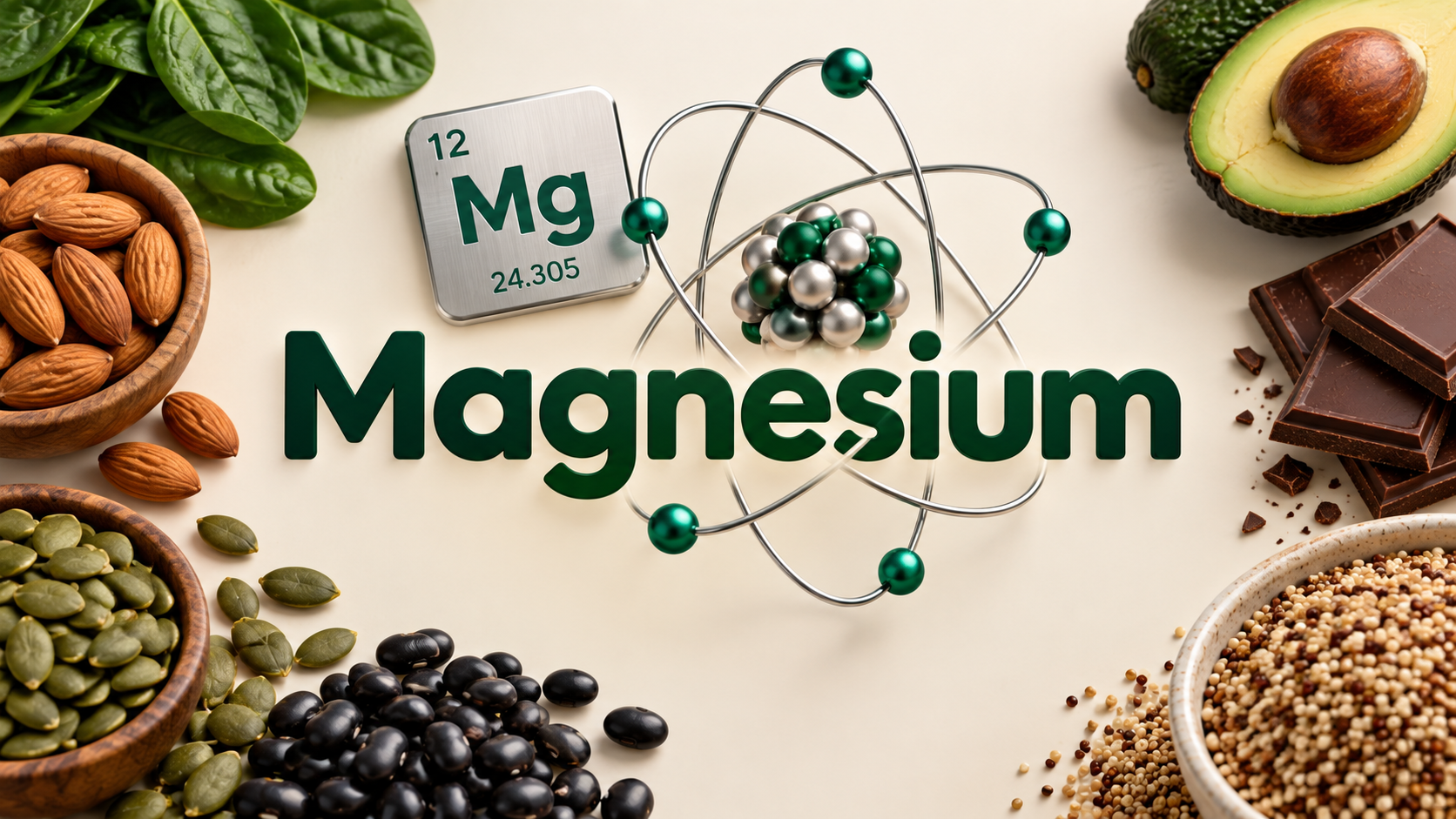
Magnesium is involved in more than 300 reactions in the body, from making energy and protein to relaxing muscles and keeping the heartbeat steady. Nuts, seeds, legumes, wholegrains and green leafy vegetables are the best sources.
What is it?
Magnesium is a major mineral. About half is stored in bone and most of the rest in muscle and soft tissue; only 1 percent is in blood. It acts as a helper (cofactor) for enzymes, including those that make ATP, the cell's energy currency.
What it does
- Helps cells make and use energy (ATP)
- Allows muscles to relax after contracting, and nerves to send signals
- Helps keep the heartbeat regular and blood pressure healthy
- Supports bone structure and blood sugar control
- Is needed for making protein and DNA
Food sources
Pumpkin seeds, chia seeds, almonds, cashews, peanuts, spinach, black beans, edamame, tofu, brown rice, oats, wholegrain bread, potatoes with skin, bananas, avocado and dark chocolate are rich sources. Refining grains removes most of their magnesium.
Singapore food examples
- Almonds, cashews, peanuts, pumpkin seeds and chia seeds
- Tofu, edamame, soya milk and tempeh
- Brown rice, oats and wholemeal bread
- Kai lan, spinach and kang kong
- Dhal, chickpeas and kidney beans
- Banana and avocado
How much do I need?
Singapore's RDA table on HealthHub does not list this nutrient, so the figures below come from US and Canadian reference intakes (Dietary Reference Intakes). Use them as a guide, and see Singapore's age- and sex-specific Recommended Dietary Allowances (HealthHub) for the nutrients Singapore does list.
The US National Academies' RDA is 400 mg a day for men aged 19 to 30 and 420 mg from 31; 310 mg for women aged 19 to 30 and 320 mg from 31, rising to 350 to 360 mg in pregnancy and 310 to 320 mg while breastfeeding.
Low intake and deficiency
Healthy kidneys conserve magnesium, so true deficiency is uncommon but low intake is not. Early signs are loss of appetite, nausea, fatigue and weakness. Severe deficiency can cause numbness, tingling, muscle cramps, seizures, personality changes and abnormal heart rhythms, and low calcium and potassium.
Risk is higher in people with type 2 diabetes, digestive disorders (Crohn's, coeliac), long-term heavy alcohol use, and older adults, and with some medicines, including proton pump inhibitors and diuretics.
Too much and safety
Magnesium from food does not cause harm in healthy people. The upper limit of 350 mg a day applies to supplements and medicines only: higher doses can cause diarrhoea, nausea and cramps. Very high doses can be dangerous in people with kidney disease, causing low blood pressure, confusion and abnormal heart rhythms.
Magnesium supplements can interfere with some antibiotics, osteoporosis drugs and thyroid hormone — separate doses and ask your pharmacist.
Absorption and bioavailability
About 30 to 40 percent of dietary magnesium is absorbed. Absorption is lower when intake is high and higher when stores are low. Phytates, oxalates and large amounts of fibre, zinc supplements and alcohol reduce it. Soaking and sprouting grains and legumes help.
Forms such as citrate, glycinate and chloride are better absorbed than oxide, though oxide is cheap and often used.
Connection to daily life
- Exercise: needed for muscle energy and relaxation; sweat loses small amounts — see Exercise
- Sleep and stress: low magnesium is associated with poorer sleep and higher stress, though supplements have not been proven to fix either — see Sleep and Stress
- Heart health: a magnesium-rich diet is linked with lower blood pressure
- Bone health: works with calcium and vitamin D
Food sources table
Amounts per serving from NIH data, ranked from highest to lowest.
Food | mg per serving | % DV |
|---|---|---|
Pumpkin seeds, roasted, 1 ounce | 156 | 37 |
Chia seeds, 1 ounce | 111 | 26 |
Almonds, dry roasted, 1 ounce | 80 | 19 |
Spinach, boiled, ½ cup | 78 | 19 |
Cashews, dry roasted, 1 ounce | 74 | 18 |
Peanuts, oil roasted, ¼ cup | 63 | 15 |
Cereal, shredded wheat, 2 large biscuits | 61 | 15 |
Soymilk, plain or vanilla, 1 cup | 61 | 15 |
Black beans, cooked, ½ cup | 60 | 14 |
Edamame, shelled, cooked, ½ cup | 50 | 12 |
Peanut butter, smooth, 2 tablespoons | 49 | 12 |
Potato, baked with skin, 3.5 ounces | 43 | 10 |
Rice, brown, cooked, ½ cup | 42 | 10 |
Yogurt, plain, low fat, 8 ounces | 42 | 10 |
Oatmeal, instant, 1 packet | 36 | 9 |
Kidney beans, canned, ½ cup | 35 | 8 |
Banana, 1 medium | 32 | 8 |
Milk, 1 cup | 27 | 6 |
Salmon, Atlantic, farmed, cooked, 3 ounces | 26 | 6 |
Halibut, cooked, 3 ounces | 24 | 6 |
Raisins, ½ cup | 23 | 5 |
Bread, whole wheat, 1 slice | 23 | 5 |
Avocado, cubed, ½ cup | 22 | 5 |
Chicken breast, roasted, 3 ounces | 22 | 5 |
Broccoli, chopped and cooked, ½ cup | 12 | 3 |
Sources: 1. NIH Office of Dietary Supplements — Magnesium Fact Sheet for Health Professionals: https://ods.od.nih.gov/factsheets/Magnesium-HealthProfessional/ 2. HealthHub Singapore — Recommended Dietary Allowances: https://www.healthhub.sg/well-being-and-lifestyle/food-diet-and-nutrition/recommended_dietary_allowances 3. Health Promotion Board — Singapore Food Insights Database (SG FoodID): https://www.hpb.gov.sg/healthy-living/food-and-beverage/sgfoodid/ 4. FAO/INFOODS — Food composition tables and databases: https://www.fao.org/food-composition/tables-and-databases/en/ 5. NIH Office of Dietary Supplements — all fact sheets: https://ods.od.nih.gov/factsheets/list-all/ Food sources table: National Institutes of Health, Office of Dietary Supplements — Magnesium Fact Sheet for Health Professionals, Table 2.
Comments
No comments yet.
Log in to leave a comment.