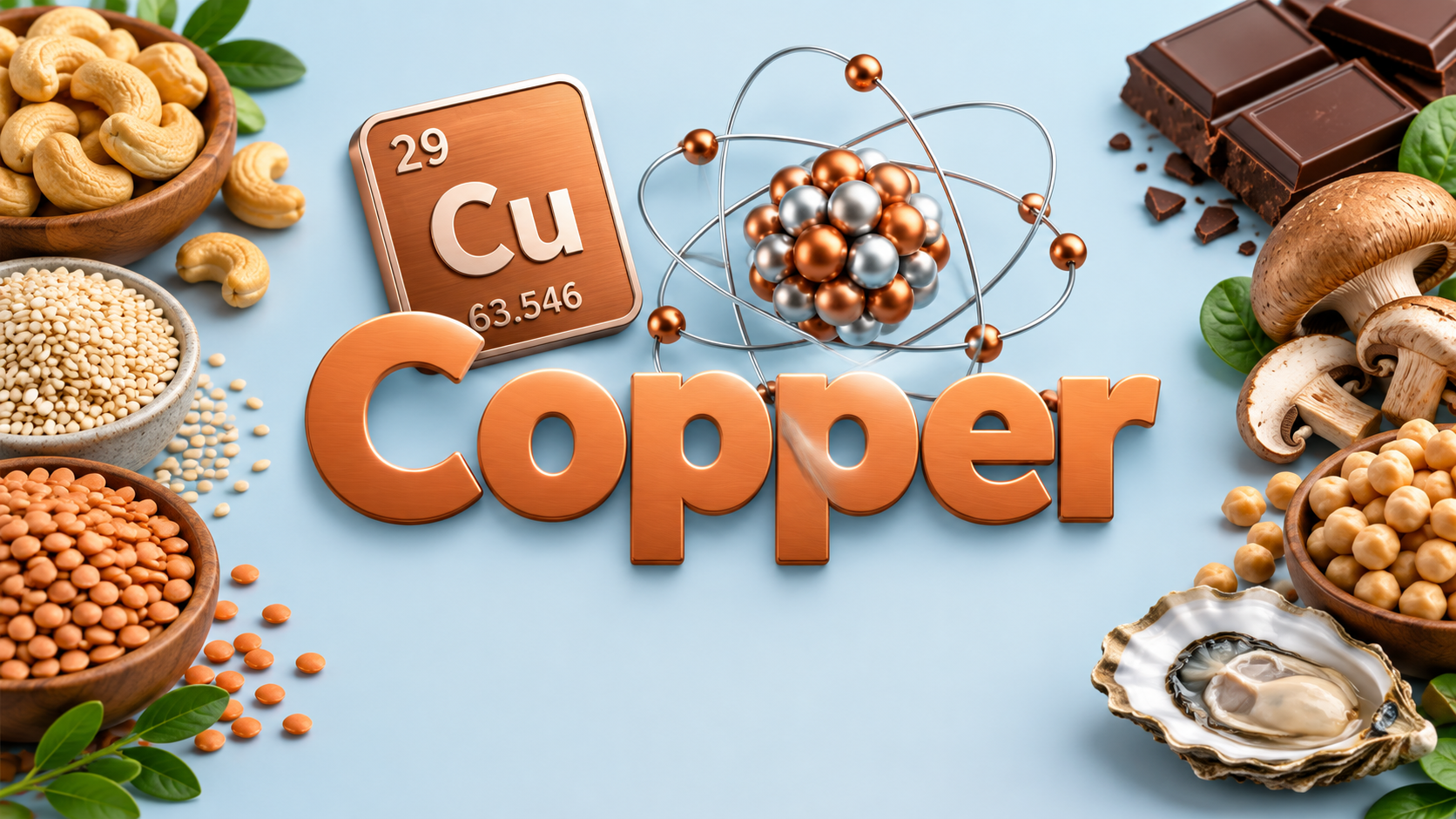
Copper is a trace mineral needed to use iron, make connective tissue, produce energy and protect cells from damage. Shellfish, nuts, seeds, wholegrains and organ meats are the best sources, and most people get enough.
What is it?
Copper is a component of several enzymes (cuproenzymes) that help with energy production, iron metabolism, building collagen, making the pigment melanin and the neurotransmitter noradrenaline, and defending against oxidative damage. The body holds only about 70 to 110 mg in total.
What it does
- Helps the body use iron and make red blood cells
- Builds and repairs connective tissue (collagen) in skin, bone and blood vessels
- Supports energy production in cells
- Supports brain and nerve function and the immune system
- Is part of antioxidant enzymes
Food sources
Oysters and other shellfish, organ meats such as liver, nuts and seeds (cashews, sesame), wholegrains, legumes, potatoes, mushrooms, dark chocolate and cocoa are the richest sources. The table at the end of this page lists amounts per serving.
Singapore food examples
- Oysters, cockles, mussels, crab and other shellfish
- Cashews, almonds, sesame seeds and tahini
- Mushrooms — shiitake especially
- Chickpeas, lentils and other legumes
- Wholegrain bread, brown rice and oats
- Liver in soups and congee, in moderation
How much do I need?
Singapore's RDA table on HealthHub does not list this nutrient, so the figures below come from US and Canadian reference intakes (Dietary Reference Intakes). Use them as a guide, and see Singapore's age- and sex-specific Recommended Dietary Allowances (HealthHub) for the nutrients Singapore does list.
The US National Academies' RDA for adults is 900 micrograms (0.9 mg) a day, rising to 1,000 micrograms in pregnancy and 1,300 micrograms while breastfeeding.
Low intake and deficiency
Deficiency is uncommon. It can cause anaemia that does not improve with iron, low white blood cell counts, bone problems, and nerve damage causing numbness, tingling and unsteadiness. It has been seen after weight-loss (gastric bypass) surgery, in coeliac disease and other malabsorption conditions, and with long-term high-dose zinc supplements, which block copper absorption. A rare inherited condition, Menkes disease, affects copper transport.
Too much and safety
Copper from food is not a concern for healthy people. The upper limit for adults is 10 mg a day. Very high intake, such as from contaminated water or supplements, can cause nausea, vomiting, abdominal pain and, over time, liver damage. People with Wilson's disease, an inherited condition in which copper builds up, must follow medical advice and limit copper.
Absorption and bioavailability
About 30 to 40 percent of dietary copper is absorbed, and the body absorbs less as intake rises. Zinc, iron and high-dose vitamin C can reduce absorption, with zinc supplements the best-known example — a reason not to take large zinc doses long-term without advice.
Connection to daily life
- Blood and energy: works with iron to keep red blood cells healthy and avoid tiredness during exercise — see Exercise
- Healthy ageing: copper supports collagen, bone and nerve function
- Supplements: if you take zinc, ask whether you also need copper
Food sources table
Amounts per serving from NIH data, ranked from highest to lowest.
Food | mcg per serving | % DV |
|---|---|---|
Beef, liver, pan fried, 3 ounces | 12,400 | 1,378 |
Oysters, eastern, wild, cooked, 3 ounces | 4,850 | 539 |
Baking chocolate, unsweetened, 1 ounce | 938 | 104 |
Potatoes, cooked, flesh and skin, 1 medium | 675 | 75 |
Mushrooms, shiitake, cooked, ½ cup | 650 | 72 |
Cashew nuts, dry roasted, 1 ounce | 629 | 70 |
Crab, Dungeness, cooked, 3 ounces | 624 | 69 |
Sunflower seed kernels, toasted, ¼ cup | 615 | 68 |
Turkey, giblets, simmered, 3 ounces | 588 | 65 |
Chocolate, dark, 70%–85% cacao, 1 ounce | 501 | 56 |
Tofu, raw, firm, ½ cup | 476 | 53 |
Chickpeas, mature seeds, ½ cup | 289 | 32 |
Millet, cooked, 1 cup | 280 | 31 |
Salmon, Atlantic, wild, cooked, 3 ounces | 273 | 30 |
Pasta, whole wheat, cooked, 1 cup | 263 | 29 |
Avocado, raw, ½ cup | 219 | 24 |
Figs, dried, ½ cup | 214 | 24 |
Spinach, boiled, drained, ½ cup | 157 | 17 |
Asparagus, cooked, drained, ½ cup | 149 | 17 |
Sesame seeds, ¼ cup | 147 | 16 |
Turkey, ground, cooked, 3 ounces | 128 | 14 |
Tomatoes, raw, chopped, ½ cup | 53 | 6 |
Yogurt, Greek, plain, low fat, 7-ounce container | 42 | 5 |
Milk, nonfat, 1 cup | 27 | 3 |
Sources: 1. NIH Office of Dietary Supplements — Copper Fact Sheet for Health Professionals: https://ods.od.nih.gov/factsheets/Copper-HealthProfessional/ 2. HealthHub Singapore — Recommended Dietary Allowances: https://www.healthhub.sg/well-being-and-lifestyle/food-diet-and-nutrition/recommended_dietary_allowances 3. Health Promotion Board — Singapore Food Insights Database (SG FoodID): https://www.hpb.gov.sg/healthy-living/food-and-beverage/sgfoodid/ 4. FAO/INFOODS — Food composition tables and databases: https://www.fao.org/food-composition/tables-and-databases/en/ 5. NIH Office of Dietary Supplements — all fact sheets: https://ods.od.nih.gov/factsheets/list-all/ Food sources table: National Institutes of Health, Office of Dietary Supplements — Copper Fact Sheet for Health Professionals, Table 2.
Comments
No comments yet.
Log in to leave a comment.