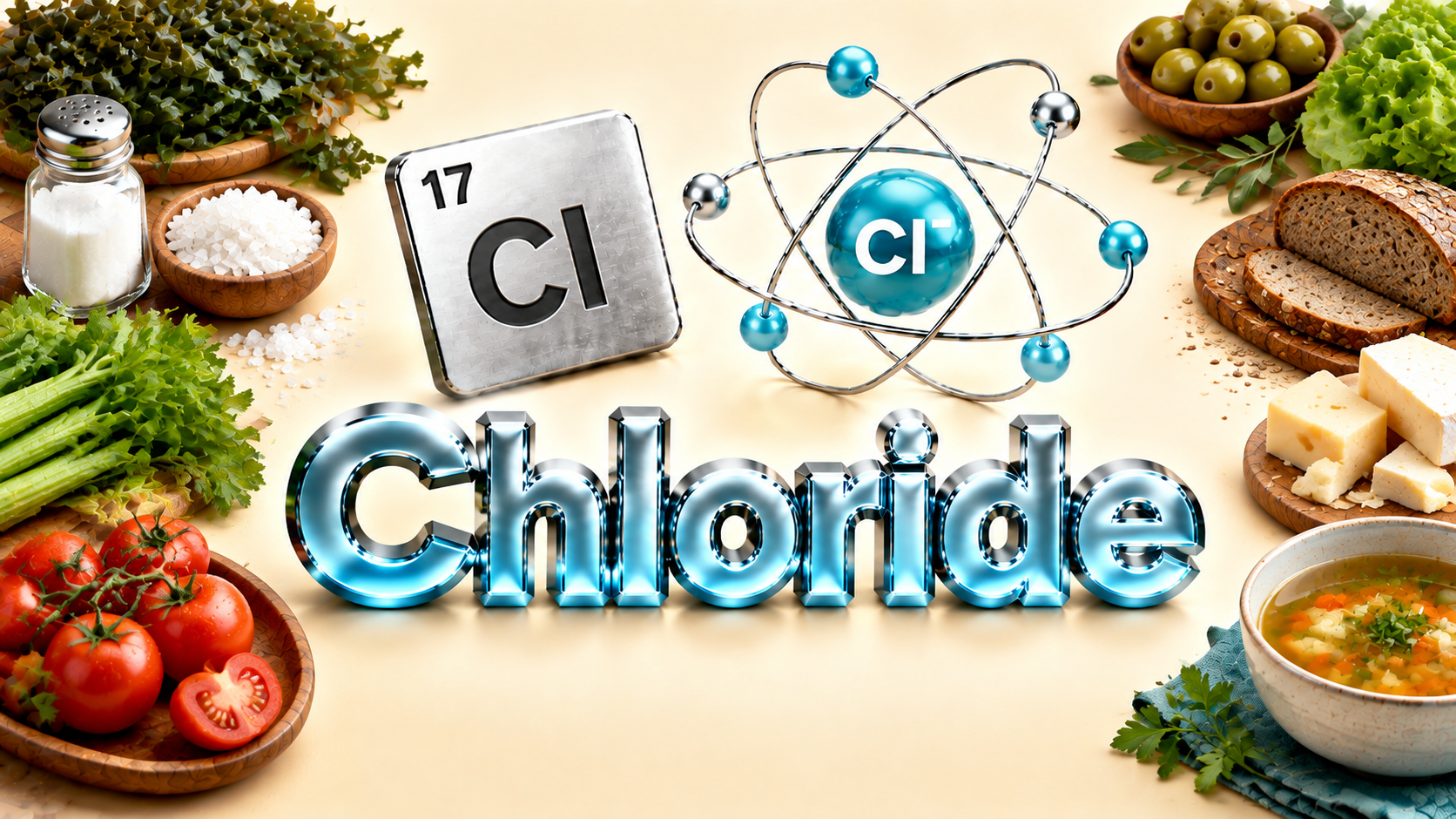
Chloride is an electrolyte that works with sodium to balance the fluids in and around cells, and it is a main ingredient of stomach acid. Nearly all chloride in the diet comes from salt (sodium chloride), so most people eat plenty.
What is it?
Chloride is a major mineral and the main negatively charged particle in the fluid around cells. About 60 percent of the weight of table salt is chloride. It is also found in the potassium chloride used as a salt substitute.
What it does
- Helps balance fluids and keep the right acid-base balance in the blood
- Is a component of hydrochloric acid, which digests food and kills germs in the stomach
- Helps nerves carry signals and helps move carbon dioxide in the blood
Food sources
Salt and anything salted — soy sauce, fish and oyster sauces, stock cubes, instant noodles, processed meat, pickles and snacks. Natural sources include seaweed, olives, tomatoes, lettuce and celery, but in small amounts.
Singapore food examples
- Soy sauce, oyster sauce, fish sauce and sambal belacan
- Stock cubes and instant noodle seasoning
- Salted fish, salted egg and preserved vegetables
- Soup and gravy in hawker dishes
- Seaweed and olives
How much do I need?
Singapore's RDA table on HealthHub does not list this nutrient, so the figures below come from US and Canadian reference intakes (Dietary Reference Intakes). Use them as a guide, and see Singapore's age- and sex-specific Recommended Dietary Allowances (HealthHub) for the nutrients Singapore does list.
The US National Academies set an Adequate Intake for chloride of 2.3 g a day for adults aged 19 to 50 (1.8 g for 51 to 70 and 1.5 g over 70), and a tolerable upper limit of 3.6 g. Eating the 5 g of salt a day Singapore recommends as a maximum gives about 3 g of chloride, so intake is rarely too low.
Low intake and deficiency
Low chloride is rare from diet alone. It occurs with prolonged vomiting, severe diarrhoea, heavy sweating without replacement, or with some diuretics and kidney conditions, and is usually found alongside low sodium. It can cause weakness, muscle cramps, dehydration and changes in blood acidity.
Too much and safety
Chloride is rarely a problem on its own; the concern with salt is mostly its sodium. High salt intake is linked to higher blood pressure — see Sodium and Singapore's guideline of less than 5 g of salt a day. People with heart, liver or kidney disease may be told to limit salt and fluid.
Absorption and bioavailability
Chloride is almost completely absorbed in the small intestine, and the kidneys keep blood levels stable by adjusting how much is lost in urine. Sweat also contains chloride, which is why heavy sweating in Singapore's heat can deplete salts, though a normal diet usually replaces them.
Connection to daily life
- Hydration and exercise: electrolytes lost in sweat matter mainly with prolonged heavy exercise or work in the heat — see Exercise
- Heart health: cutting salt lowers both sodium and chloride intake
- Digestion: stomach acid depends on chloride, and low stomach acid affects absorption of vitamin B12 and iron
Sources: 1. National Academies of Sciences, Engineering, and Medicine — Dietary Reference Intakes for Sodium and Potassium (2019), which also sets chloride intakes 2. HealthHub Singapore — Recommended Dietary Allowances: https://www.healthhub.sg/well-being-and-lifestyle/food-diet-and-nutrition/recommended_dietary_allowances 3. HealthHub Singapore — Dietary guidelines for adults: https://www.healthhub.sg/well-being-and-lifestyle/food-diet-and-nutrition/dietary_guidelines_adults 4. Health Promotion Board — Singapore Food Insights Database (SG FoodID): https://www.hpb.gov.sg/healthy-living/food-and-beverage/sgfoodid/ 5. FAO/INFOODS — Food composition tables and databases: https://www.fao.org/food-composition/tables-and-databases/en/
Comments
No comments yet.
Log in to leave a comment.