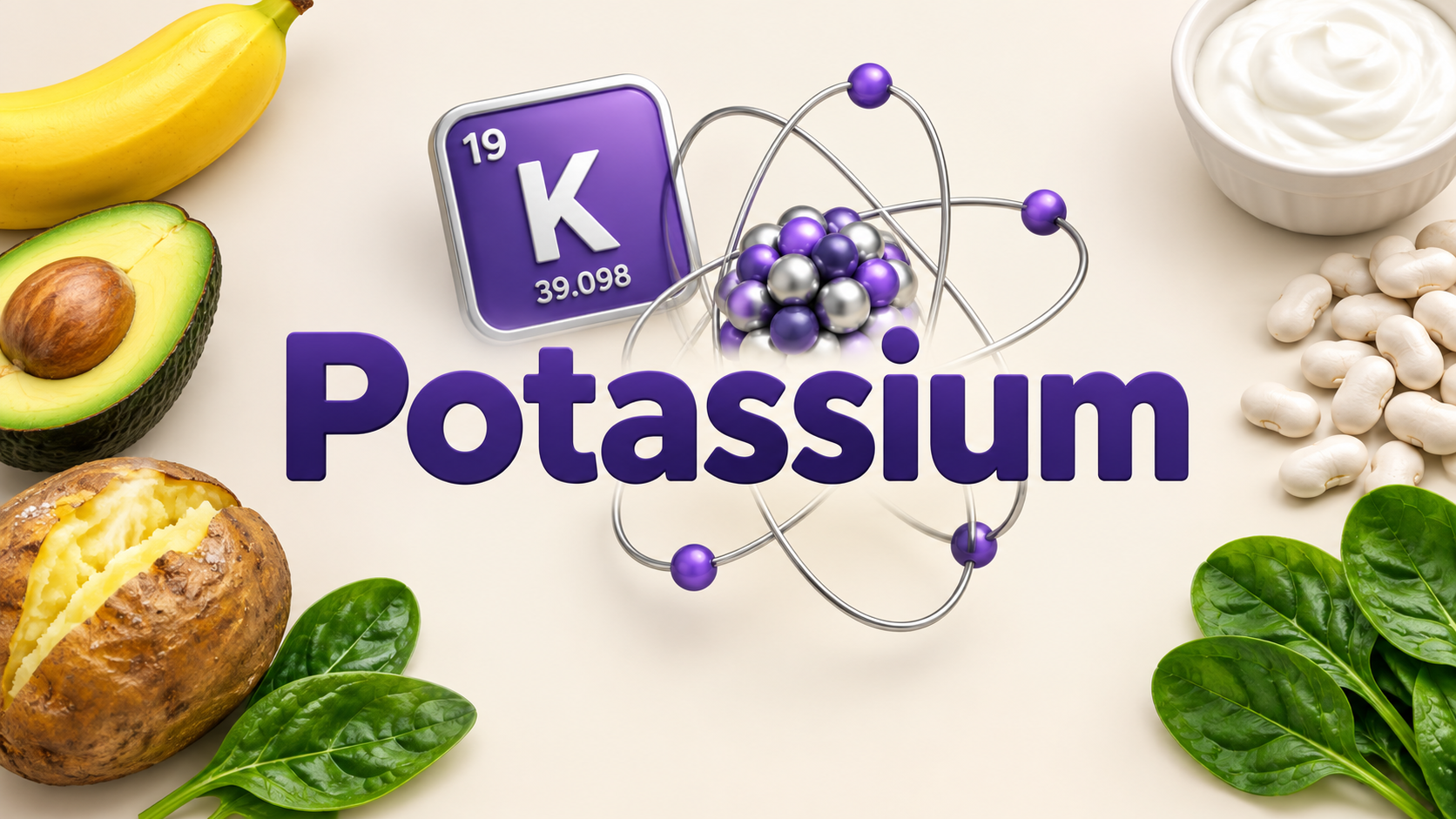
Potassium is an electrolyte that helps balance fluids inside and outside the body's cells and supports normal nerve and muscle function, including the heartbeat. It is found in many fruits, vegetables and legumes, and a potassium-rich diet helps lower blood pressure.
What is it?
Potassium is a major mineral and the main positively charged particle inside cells. It works as a counterbalance to sodium: eating more potassium helps the kidneys excrete sodium, which is one reason a diet rich in fruit and vegetables is good for blood pressure.
What it does
- Balances fluids and electrolytes inside and outside cells
- Lets nerves send signals and muscles, including the heart, contract
- Helps lower blood pressure by helping the body remove sodium
- Supports bone health and may lower kidney stone risk
Food sources
Potatoes and sweet potatoes, bananas, avocado, spinach and other leafy greens, tomatoes, beans, lentils, coconut water, oranges, yoghurt, milk, fish and nuts are rich in potassium.
Singapore food examples
- Bananas, papaya and oranges
- Coconut water (fresh)
- Sweet potato, potato and pumpkin
- Kai lan, spinach and kang kong
- Beans, dhal and tofu
- Fish, chicken and yoghurt
How much do I need?
Singapore's RDA table on HealthHub does not list this nutrient, so the figures below come from US and Canadian reference intakes (Dietary Reference Intakes). Use them as a guide, and see Singapore's age- and sex-specific Recommended Dietary Allowances (HealthHub) for the nutrients Singapore does list.
The US National Academies set an Adequate Intake of 3,400 mg a day for men and 2,600 mg for women (2,900 mg in pregnancy and 2,800 mg when breastfeeding). Many people eat less than this.
Low intake and deficiency
Low potassium intake raises blood pressure, especially when sodium is high, and is linked to a higher risk of stroke, kidney stones and bone loss. A low blood potassium level (hypokalaemia) usually comes from vomiting, diarrhoea, heavy sweating or water pills, and causes weakness, muscle cramps, constipation, palpitations and irregular heartbeats.
Too much and safety
In healthy people, the kidneys remove extra potassium from food. People with chronic kidney disease, and people who take ACE inhibitors, ARB medicines or potassium-sparing diuretics, can develop dangerously high blood potassium (hyperkalaemia), causing weakness and heart rhythm problems. They should ask their doctor before eating a high-potassium diet.
Salt substitutes and "low-sodium" salts are often potassium chloride; people with kidney disease or on those medicines should check with their doctor before using them. Potassium supplements are limited in strength for safety.
Absorption and bioavailability
About 85 to 90 percent of dietary potassium is absorbed. Potassium dissolves in water, so boiling vegetables and discarding the water removes a lot; steaming, microwaving and using the cooking liquid in soups keeps more. Sweat loses small amounts.
Connection to daily life
- Heart and blood pressure health: eating more potassium and less sodium is one of the best food steps for blood pressure
- Exercise: needed for muscle contraction and lost in sweat, but a normal diet covers it — see Exercise
- Healthy ageing: supports bone and kidney health; check with your doctor if you take blood-pressure or kidney medicines
Sources: 1. NIH Office of Dietary Supplements — Potassium Fact Sheet for Health Professionals: https://ods.od.nih.gov/factsheets/Potassium-HealthProfessional/ 2. HealthHub Singapore — Recommended Dietary Allowances: https://www.healthhub.sg/well-being-and-lifestyle/food-diet-and-nutrition/recommended_dietary_allowances 3. Health Promotion Board — Singapore Food Insights Database (SG FoodID): https://www.hpb.gov.sg/healthy-living/food-and-beverage/sgfoodid/ 4. FAO/INFOODS — Food composition tables and databases: https://www.fao.org/food-composition/tables-and-databases/en/ 5. NIH Office of Dietary Supplements — all fact sheets: https://ods.od.nih.gov/factsheets/list-all/
Comments
No comments yet.
Log in to leave a comment.