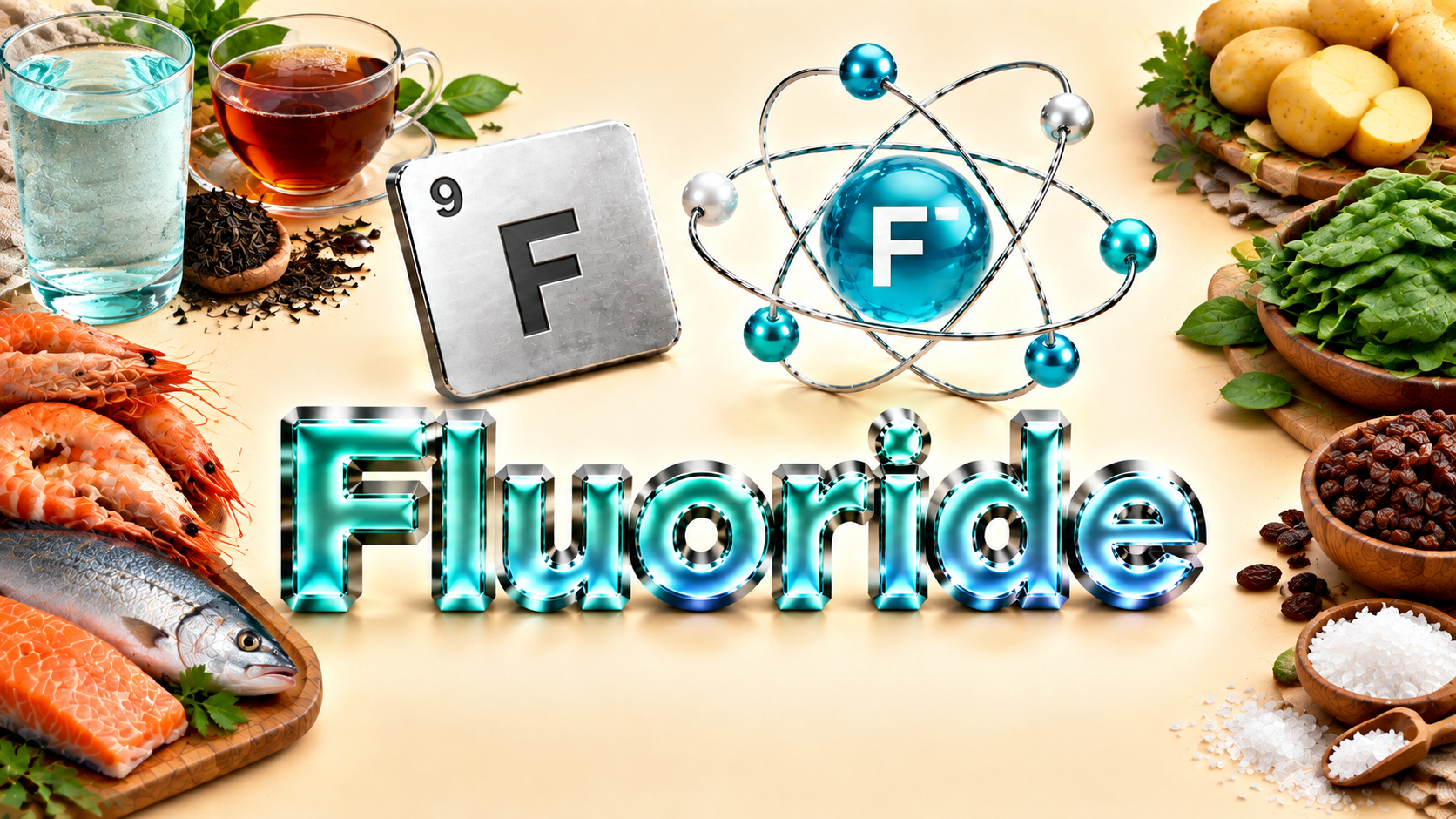
Fluoride is a trace mineral that hardens tooth enamel and helps prevent tooth decay. Singapore has added it to its tap water since 1957, and most people also get it from toothpaste, tea and seafood.
What is it?
Fluoride is the ion form of the element fluorine. It builds into tooth enamel as a more acid-resistant mineral (fluorapatite), and in saliva and plaque it slows enamel loss and bacterial acid production. It is also deposited in bone.
What it does
- Strengthens developing and adult tooth enamel and makes it more resistant to acid
- Reduces tooth decay (dental caries), the main benefit
- Can help repair early enamel damage
Food sources
The main dietary source is fluoridated drinking water and foods and drinks made with it. Tea is naturally rich in fluoride, and seafood (especially fish eaten with their bones, such as sardines), and some wines contain smaller amounts. Most other foods contain very little.
Singapore food examples
- Fluoridated tap water — Singapore has added fluoride to tap water since 1957
- Tea, especially brewed from older leaves
- Sardines, ikan bilis and other small fish eaten with their bones
- Fluoride toothpaste, used twice a day
- Dentist-applied fluoride varnish for children at higher risk
How much do I need?
Singapore's RDA table on HealthHub does not list this nutrient, so the figures below come from US and Canadian reference intakes (Dietary Reference Intakes). Use them as a guide, and see Singapore's age- and sex-specific Recommended Dietary Allowances (HealthHub) for the nutrients Singapore does list.
The US National Academies set an Adequate Intake of 4 mg a day for men and 3 mg for women. For children, the aim is enough fluoride to prevent decay without causing fluorosis: see your dentist or doctor for guidance on toothpaste amounts by age.
Low intake and deficiency
Low fluoride exposure increases the risk of tooth decay in children and adults. The benefit comes mostly from contact with teeth (toothpaste, water, varnish) rather than from swallowing it.
Too much and safety
The tolerable upper limit for adults is 10 mg a day. Too much fluoride while teeth are forming (up to about age 8) causes dental fluorosis, ranging from faint white flecks to brown staining and pitting. For this reason, young children should use only a small, pea-sized smear of fluoride toothpaste and be supervised so they spit rather than swallow.
Very high long-term intake, from heavily fluoride-contaminated water in some countries, can cause skeletal fluorosis (stiff, painful bones and joints). It is not a concern with Singapore's regulated water.
Absorption and bioavailability
Fluoride is well absorbed — about 90 percent or more from water and tea — mostly in the stomach and small intestine. Calcium-rich foods and aluminium-containing antacids bind it and reduce absorption. It is taken up by bones and teeth, and the kidneys excrete the rest.
Connection to daily life
- Dental health: brush twice daily with fluoride toothpaste and limit sugary snacks and drinks
- Children: supervise toothbrushing and use only a pea-sized amount
- Healthy ageing: older adults with dry mouth or exposed tooth roots are at higher risk of decay and benefit from fluoride
- Related: sugar frequency matters more than total sugar for teeth — see Sugars
Sources: 1. National Academies of Sciences, Engineering, and Medicine — Dietary Reference Intakes for Calcium, Phosphorus, Magnesium, Vitamin D and Fluoride (1997) 2. HealthHub Singapore — Recommended Dietary Allowances: https://www.healthhub.sg/well-being-and-lifestyle/food-diet-and-nutrition/recommended_dietary_allowances 3. Health Promotion Board — Singapore Food Insights Database (SG FoodID): https://www.hpb.gov.sg/healthy-living/food-and-beverage/sgfoodid/ 4. FAO/INFOODS — Food composition tables and databases: https://www.fao.org/food-composition/tables-and-databases/en/
Comments
No comments yet.
Log in to leave a comment.