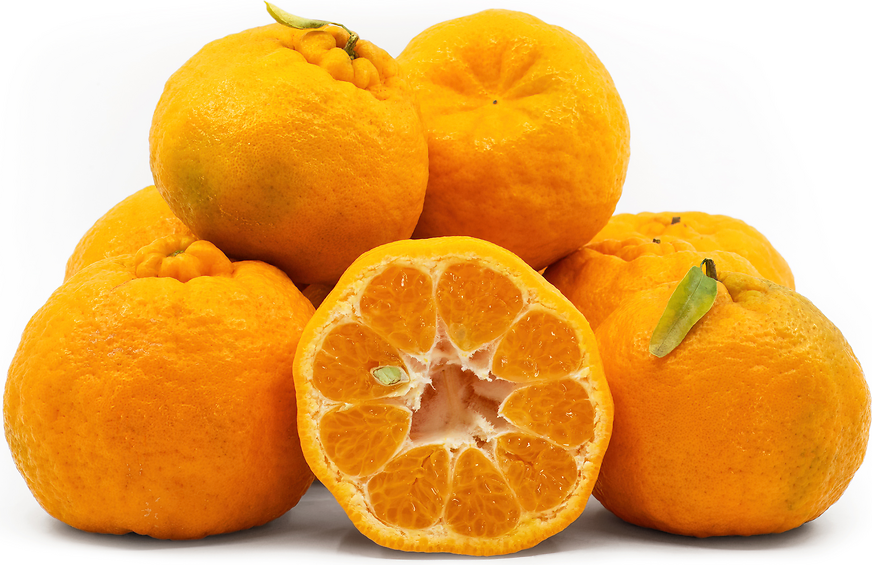
Name: Ugli fruit (trademarked UGLI®), also known as the Jamaican tangelo — a natural hybrid of grapefruit (or pomelo) and tangerine or orange, closely related to the tangelo and Minneola described on their own pages, though ugli fruit arose in the wild rather than through deliberate breeding.
Description
The ugli fruit was discovered growing wild in Jamaica around 1917, and was developed over several generations of grafting from the 1930s onward by the Sharp family of Trout Hall plantation in Clarendon Parish, selecting for fewer seeds along the way. It was exported to Canada and England by 1934, and reached the United States by 1942.
Its name plays on “ugly,” referring to the fruit's rough, wrinkled, greenish-yellow rind, which turns more orange as it ripens — in sharp contrast to the sweet, juicy, fragrant flesh inside, which leans toward the tangerine side of its parentage rather than the bitter grapefruit side.
Main nutrition value
Per 100g, USDA-derived grapefruit data (the closest documented match) lists approximately 32 kcal, 8.1g carbohydrate, 7g naturally occurring sugars, 1.1g dietary fibre, and under 1g each of protein and fat. Like grapefruit, ugli fruit is a good source of vitamin C and potassium, with a distinctive amount of lycopene contributing to its inner colour.
How best to be consumed
Despite its rough appearance, the rind is thick and loose and peels away more easily than a grapefruit's, closer to how a mandarin peels.
- Peel by hand rather than cutting, since the loose rind comes away easily despite its rough look.
- Separate into segments and eat fresh, or press for juice.
- Add segments to salads for a sweet-tart flavour milder than grapefruit.
- Choose fruit that feels heavy for its size, a better ripeness indicator than the rough skin appearance.
- Avoid pairing heavily with medications that carry a grapefruit-juice warning label, given ugli fruit's direct grapefruit parentage.
Overconsumption could cause…
As a fruit with direct grapefruit parentage, a couple of considerations apply beyond the usual citrus caution.
- Medication interaction: ugli fruit contains some of the same furanocoumarin compounds as grapefruit that interfere with how the body processes certain medications — check with a pharmacist or doctor if you take a medication with a grapefruit warning.
- Digestive discomfort from a large amount of fibre and citrus acid at once.
- Tooth enamel exposure with very frequent intake, given the fruit's natural acidity.
U.S. Department of Agriculture, FoodData Central — Grapefruit, raw, pink and red and white, all areas (100g portion): https://fdc.nal.usda.gov/food-details/173033/nutrients (no USDA entry exists for ugli fruit, a natural grapefruit-tangerine hybrid; the general grapefruit figures below are the closest documented relative) Wikipedia — Jamaican tangelo (Ugli fruit), used for discovery and naming history: https://en.wikipedia.org/wiki/Jamaican_tangelo
Comments
No comments yet.
Log in to leave a comment.