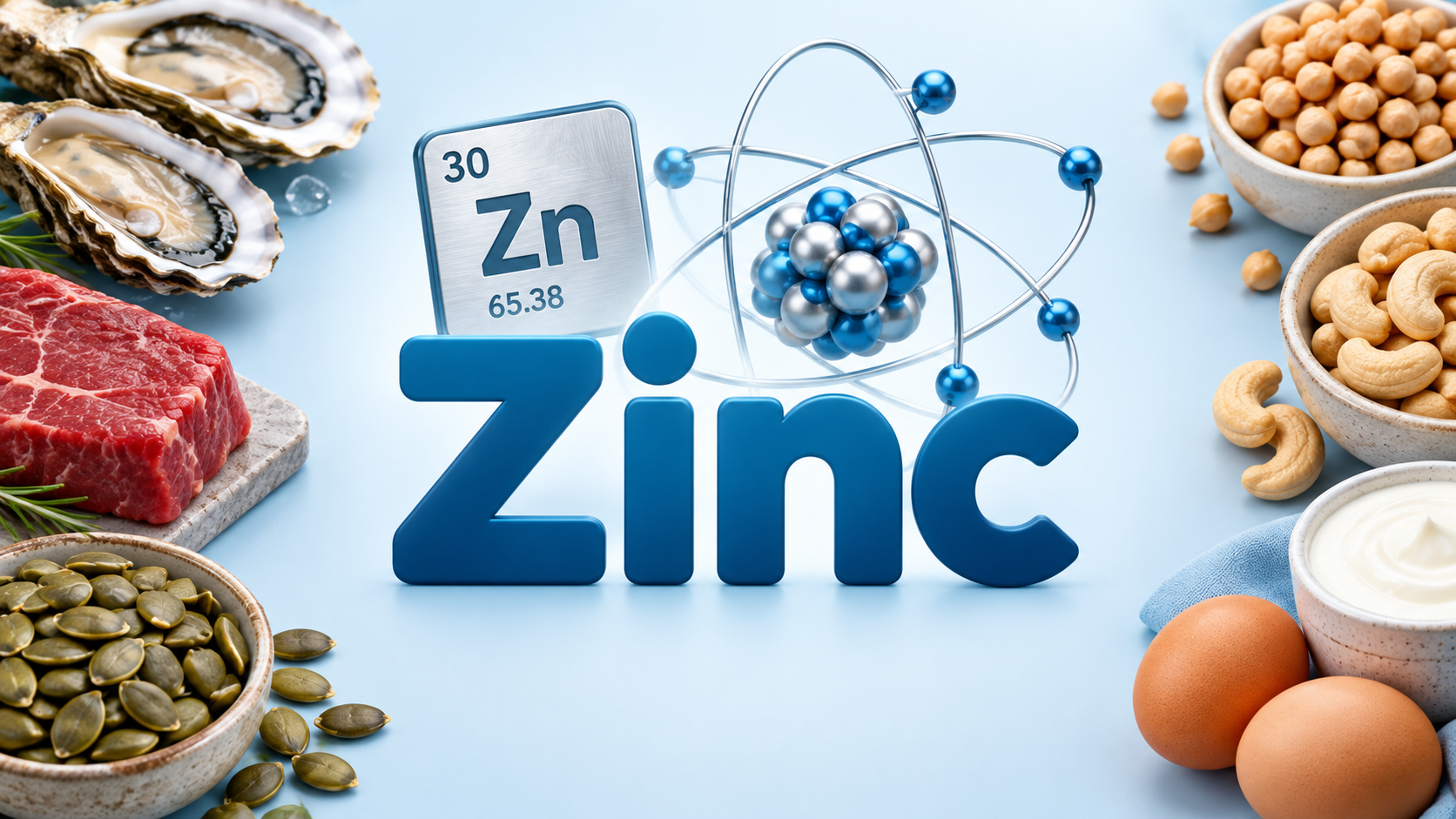
Zinc is a trace mineral needed for immune function, wound healing, growth, DNA and protein synthesis, and the senses of taste and smell. Oysters, red meat, shellfish, legumes, nuts and seeds are the richest sources.
What is it?
Zinc is part of more than 300 enzymes and helps regulate genes and cell signalling. The body does not store much zinc, so a steady daily intake matters. The zinc needs of vegetarians may be up to 50 percent higher than those of meat eaters, because plant zinc is absorbed less well.
What it does
- Supports normal immune function and helps fight infections
- Is needed for wound healing and healthy skin
- Supports growth and development, including in pregnancy and childhood
- Is needed to make DNA and protein
- Supports the senses of taste and smell
Food sources
Oysters are by far the richest source. Beef, lamb, crab, lobster, pork, dark chicken meat, pumpkin seeds, cashews, chickpeas, lentils, dairy, fortified cereals and wholegrains also provide good amounts. The table at the end of this page lists amounts per serving.
Singapore food examples
- Oysters, crab, prawns and other shellfish
- Beef, mutton, pork and dark chicken meat
- Pumpkin seeds, cashews and sesame seeds
- Chickpeas, lentils and tofu
- Yoghurt and cheese
- Fortified breakfast cereals — check the label
How much do I need?
Singapore's RDA table on HealthHub does not list this nutrient, so the figures below come from US and Canadian reference intakes (Dietary Reference Intakes). Use them as a guide, and see Singapore's age- and sex-specific Recommended Dietary Allowances (HealthHub) for the nutrients Singapore does list.
The US National Academies' RDA is 11 mg a day for men and 8 mg for women, 11 mg in pregnancy and 12 mg while breastfeeding.
Low intake and deficiency
Zinc deficiency causes slow growth in children, loss of appetite, diarrhoea, hair loss, slow wound healing, skin lesions, poor immunity, and loss of taste and smell. It is more common in people with limited diets, pregnancy and breastfeeding, digestive disorders (Crohn's, coeliac, after bariatric surgery), long-term heavy alcohol use, chronic kidney disease, and in older adults and vegetarians.
Too much and safety
The upper limit for adults is 40 mg a day from food and supplements. Too much zinc causes nausea, vomiting, stomach cramps, diarrhoea and headaches. Over weeks to months, high doses lower copper levels, causing anaemia and low white blood cells, and may reduce "good" HDL cholesterol.
Zinc nasal sprays and swabs have been linked to permanent loss of smell, and are best avoided. Zinc can interact with some antibiotics (quinolones and tetracyclines), penicillamine and diuretics — ask your pharmacist.
Absorption and bioavailability
About 20 to 40 percent of dietary zinc is absorbed. Animal protein improves absorption; phytates in wholegrains and legumes reduce it. Soaking, sprouting, fermenting and leavening reduce phytates. High-dose iron and calcium supplements can compete with zinc when taken together.
Connection to daily life
- Immunity: supports immune cells, though extra zinc does not prevent colds in people who are not deficient
- Skin and wound healing: needed for repair after injuries and surgery
- Plant-based eating: include legumes, nuts, seeds and soaked or fermented grains, and consider a supplement if advised
- Exercise: lost in sweat in small amounts; endurance athletes should eat zinc-rich foods — see Exercise
Food sources table
Amounts per serving from NIH data, ranked from highest to lowest.
Food | mg per serving | % DV |
|---|---|---|
Oysters, Eastern, farmed, raw, 3 ounces | 32 | 291 |
Oysters, Pacific, cooked, 3 ounces | 28.2 | 256 |
Beef, bottom sirloin, roasted, 3 ounces | 3.8 | 35 |
Blue crab, cooked, 3 ounces | 3.2 | 29 |
Breakfast cereals, fortified with 25% of the DV, 1 serving | 2.8 | 25 |
Cereals, oats, regular and quick, cooked with water, 1 cup | 2.3 | 21 |
Pumpkin seeds, roasted, 1 ounce | 2.2 | 20 |
Pork, center loin (chops), bone in, broiled, 3 ounces | 1.9 | 17 |
Turkey breast, meat only, roasted, 3 ounces | 1.5 | 14 |
Cheese, cheddar, 1.5 ounces | 1.5 | 14 |
Shrimp, cooked, 3 ounces | 1.4 | 13 |
Lentils, boiled, ½ cup | 1.3 | 12 |
Sardines, canned in oil, drained, 3 ounces | 1.1 | 10 |
Greek yogurt, plain, 6 ounces | 1.0 | 9 |
Milk, 1% milkfat, 1 cup | 1.0 | 9 |
Peanuts, dry roasted, 1 ounce | 0.8 | 7 |
Rice, brown, long grain, cooked, ½ cup | 0.7 | 6 |
Egg, 1 large | 0.6 | 5 |
Kidney beans, canned, ½ cup | 0.6 | 5 |
Bread, whole wheat, 1 slice | 0.6 | 5 |
Fish, salmon, cooked, 3 ounces | 0.5 | 5 |
Broccoli, chopped, cooked, ½ cup | 0.4 | 4 |
Sources: 1. NIH Office of Dietary Supplements — Zinc Fact Sheet for Health Professionals: https://ods.od.nih.gov/factsheets/Zinc-HealthProfessional/ 2. HealthHub Singapore — Recommended Dietary Allowances: https://www.healthhub.sg/well-being-and-lifestyle/food-diet-and-nutrition/recommended_dietary_allowances 3. Health Promotion Board — Singapore Food Insights Database (SG FoodID): https://www.hpb.gov.sg/healthy-living/food-and-beverage/sgfoodid/ 4. FAO/INFOODS — Food composition tables and databases: https://www.fao.org/food-composition/tables-and-databases/en/ 5. NIH Office of Dietary Supplements — all fact sheets: https://ods.od.nih.gov/factsheets/list-all/ Food sources table: National Institutes of Health, Office of Dietary Supplements — Zinc Fact Sheet for Health Professionals, Table 2.
Comments
No comments yet.
Log in to leave a comment.