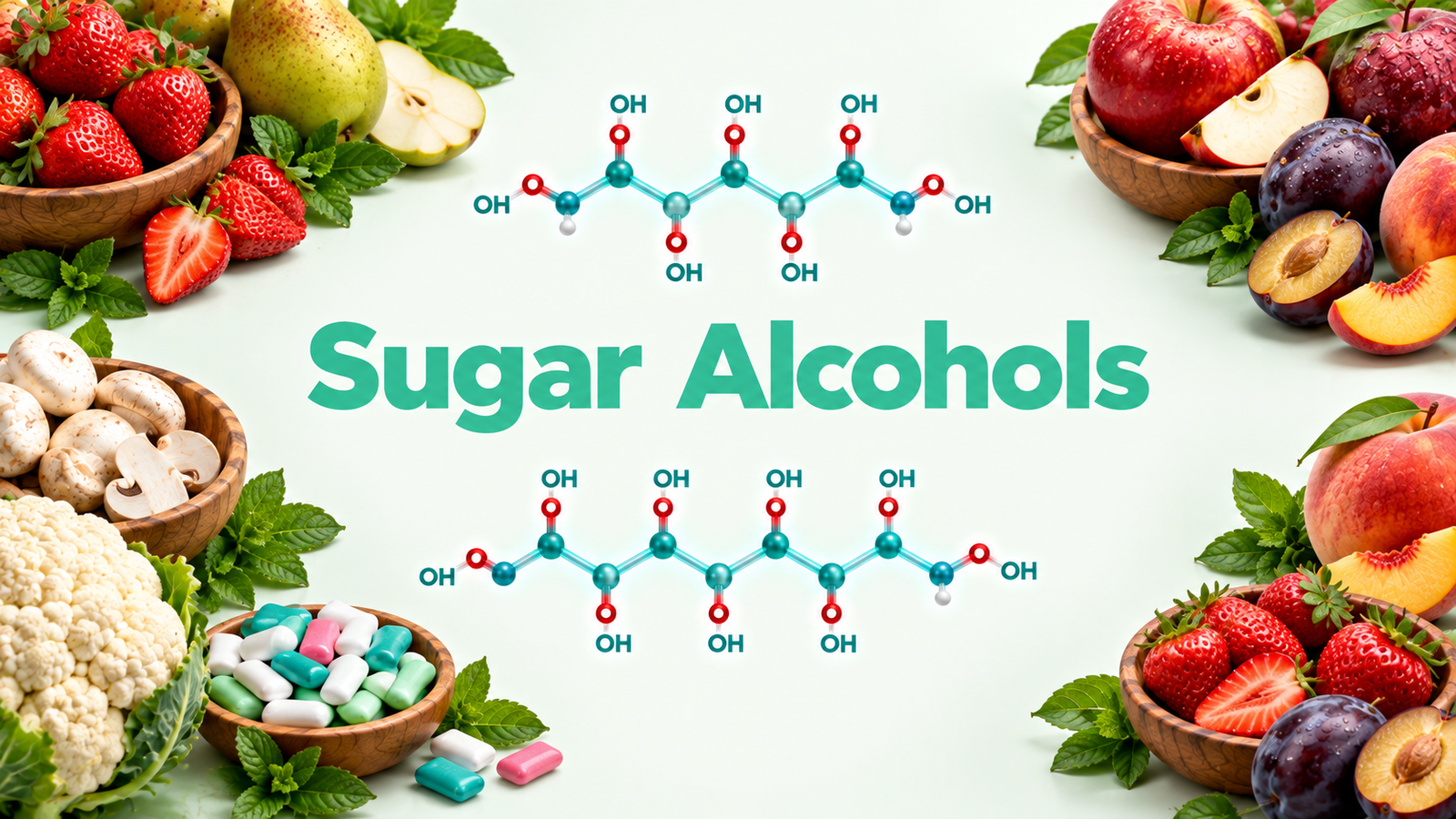
Sugar alcohols (polyols) are sweeteners such as sorbitol, xylitol, erythritol, maltitol and mannitol. They taste sweet, supply fewer calories than sugar and do not cause tooth decay, but eating a lot can cause gas, bloating and diarrhoea.
What is it?
Despite the name, sugar alcohols are neither sugar nor the alcohol in drinks. They are a type of carbohydrate with a chemical structure partly like sugar and partly like alcohol. They are found naturally in small amounts in some fruit and vegetables and are made commercially for sugar-free gum, sweets, chocolate, baked goods, "no added sugar" products and some medicines and toothpaste.
What it does
- Add sweetness with about 0 to 3 kilocalories per gram instead of 4 for sugar (erythritol is close to 0)
- Raise blood glucose much less than sugar, so are used in some diabetic-friendly products
- Do not feed the bacteria that cause tooth decay; xylitol may help protect teeth
- Add bulk and texture to sugar-free foods
Food sources
Sugar-free chewing gum and sweets, "no added sugar" chocolate, ice cream and baked goods, some protein bars and low-sugar syrups. Naturally in small amounts in apples, pears, plums and prunes (sorbitol) and mushrooms (mannitol). Check ingredient lists for names ending in "-ol" and E-numbers such as E420 (sorbitol), E967 (xylitol), E968 (erythritol).
Singapore food examples
- Sugar-free gum and mints
- "No added sugar" or diabetic chocolates and biscuits
- Protein bars and low-sugar snacks
- Prunes, apples and pears (natural sorbitol)
- Sugar-free cough sweets and lozenges
How much do I need?
There is no recommended intake for sugar alcohols and Singapore's RDA table does not list them. Regulators set acceptable daily intakes for some, and set a labelling requirement in many countries: products with large amounts may carry a warning that excess consumption may have a laxative effect. Keep them occasional and compare labels.
Low intake and deficiency
There is no deficiency; the body does not need sugar alcohols.
Too much and safety
Sugar alcohols are only partly absorbed, so the rest ferments in the large intestine. Amounts above roughly 10 to 20 g a day (less for sorbitol and maltitol; erythritol is better tolerated) can cause gas, bloating, cramps and a laxative effect. People with irritable bowel syndrome may react to small amounts.
Xylitol is highly toxic to dogs — keep sugar-free gum and sweets away from pets. An observational study found that higher blood levels of erythritol were linked to cardiovascular events, and follow-up research is ongoing; the evidence is not conclusive, but it is a reason not to rely on sugar alcohols heavily.
"Sugar-free" does not mean calorie-free or healthy: check the label.
Absorption and bioavailability
Absorption varies: erythritol is mostly absorbed in the small intestine and passed out in urine unchanged (about 90 percent), while sorbitol, maltitol and xylitol are poorly absorbed and fermented in the colon. This is why they provide fewer calories and why they can cause gas and loose stools.
Connection to daily life
- Dental health: xylitol gum after meals can help protect teeth
- Blood sugar: lower glycaemic effect than sugar, but not a licence to eat more — see Sugars
- Digestive comfort: introduce slowly and watch for symptoms
Sources: 1. National Academies of Sciences, Engineering, and Medicine — Dietary Reference Intakes for Energy, Carbohydrate, Fiber, Fat, Fatty Acids, Cholesterol, Protein, and Amino Acids (2005) 2. HealthHub Singapore — Dietary guidelines for adults: https://www.healthhub.sg/well-being-and-lifestyle/food-diet-and-nutrition/dietary_guidelines_adults 3. Health Promotion Board — Singapore Food Insights Database (SG FoodID): https://www.hpb.gov.sg/healthy-living/food-and-beverage/sgfoodid/ 4. FAO/INFOODS — Food composition tables and databases: https://www.fao.org/food-composition/tables-and-databases/en/
Comments
No comments yet.
Log in to leave a comment.