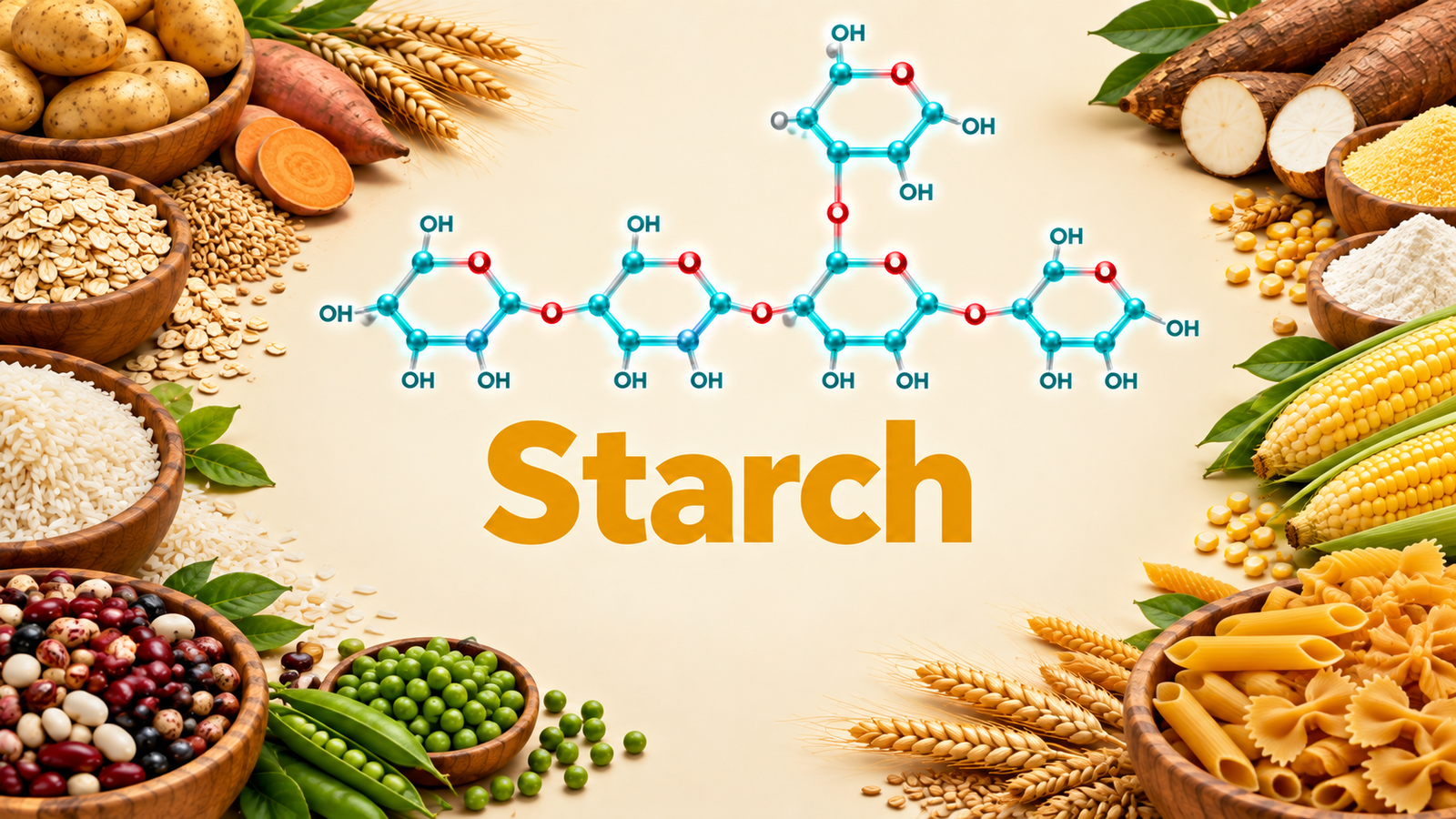
Starch is the main way plants store carbohydrate, and the most common carbohydrate in the human diet. It is made of long chains of glucose that the body breaks down into glucose for energy.
What is it?
Starch has two forms: amylose, a long straight chain that digests more slowly and forms more resistant starch, and amylopectin, a highly branched chain that digests quickly. The balance varies by food. Long-grain and basmati rice and many legumes are higher in amylose and raise blood sugar more slowly; glutinous (sticky) rice is almost all amylopectin and digests quickly.
Starch can also be classed as rapidly digestible, slowly digestible or resistant, depending on how quickly the small intestine digests it. Resistant starch acts like fibre and is fermented by gut bacteria in the colon.
What it does
- Provides a steady supply of glucose for the brain, muscles and other tissues
- Resistant starch feeds gut bacteria and may support gut health
- Provides energy at about 4 kilocalories per gram
Food sources
Rice, wheat (bread, noodles, pasta), oats, corn, potatoes, sweet potato, yam, cassava (tapioca), sago, legumes and unripe bananas. Wholegrain and minimally processed starchy foods keep more fibre and nutrients.
Singapore food examples
- Rice, noodles, bee hoon, kway teow, mee pok and mee kia
- Bread, roti prata, chapati, thosai and idli
- Potatoes, sweet potatoes, yam and tapioca
- Lotus root, corn and pumpkin
- Beans, dhal and chickpeas
- Kueh, which are often made from rice flour, tapioca or glutinous rice
How much do I need?
Starch has no separate recommended intake. It counts toward your carbohydrate intake; Singapore's guidelines suggest that at least half of grain foods come from wholegrain — see Singapore's dietary guidelines for adults (HealthHub) and Carbohydrates.
Low intake and deficiency
There is no deficiency from low starch itself; low starch means low carbohydrate and usually low fibre and energy. See the Carbohydrates page for signs of very low carbohydrate intake.
Too much and safety
Eating more starchy food than you need adds to total energy and weight gain. Refined starches (white rice, white bread, many snacks and noodles) are digested quickly and raise blood sugar more, especially in large portions. Choose wholegrain and mixed-grain versions, keep portions reasonable (the Healthy Plate suggests about a quarter of the plate), and eat with vegetables and protein.
Overcooked rice or pasta, and starchy foods left at room temperature, can allow bacteria to grow: refrigerate leftovers promptly and reheat until piping hot.
Absorption and bioavailability
Starch is digested by enzymes in saliva and the small intestine. Cooking in water swells (gelatinises) the starch and makes it easier to digest. Cooling cooked starch then makes some of it turn into resistant starch, and reheating it keeps much of that resistant starch — so chilled, reheated rice or potatoes digest a little more slowly than freshly cooked ones.
Intact grains, al dente cooking, and pairing with protein, fat, vinegar or vegetables slow digestion.
Connection to daily life
- Exercise: starch stored as glycogen powers endurance and high-intensity activity — see Exercise
- Blood sugar: type and portion of starch affect energy and blood sugar after meals
- Gut health: resistant starch feeds the bacteria that make butyrate
Sources: 1. National Academies of Sciences, Engineering, and Medicine — Dietary Reference Intakes for Energy, Carbohydrate, Fiber, Fat, Fatty Acids, Cholesterol, Protein, and Amino Acids (2005) 2. HealthHub Singapore — Recommended Dietary Allowances: https://www.healthhub.sg/well-being-and-lifestyle/food-diet-and-nutrition/recommended_dietary_allowances 3. HealthHub Singapore — Dietary guidelines for adults: https://www.healthhub.sg/well-being-and-lifestyle/food-diet-and-nutrition/dietary_guidelines_adults 4. Health Promotion Board — Singapore Food Insights Database (SG FoodID): https://www.hpb.gov.sg/healthy-living/food-and-beverage/sgfoodid/ 5. FAO/INFOODS — Food composition tables and databases: https://www.fao.org/food-composition/tables-and-databases/en/
Comments
No comments yet.
Log in to leave a comment.